

State Disability Insurance (SDI) Tax Explained: How It Works, Who Pays, and What Employers Owe

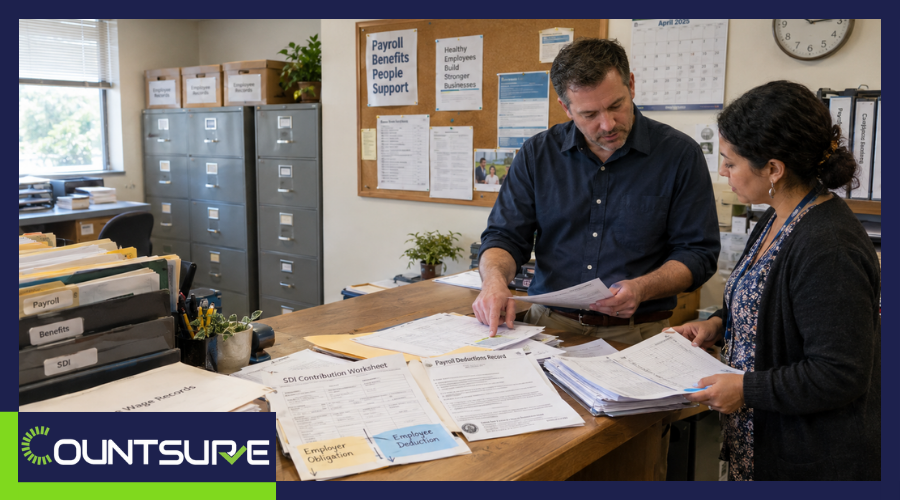
The short answer: SDI (State Disability Insurance) is a state payroll tax that funds short-term, partial wage replacement for workers who cannot work because of a non-work-related illness, injury or pregnancy. Only California, Hawaii, New Jersey, New York, Rhode Island and Puerto Rico run these programs. Depending on the state it is paid by the employee, or shared with the employer, and the employer always withholds and remits it. In California the 2026 rate is 1.3% of all wages, paid by the employee.
Key Takeaways
- What it covers: short-term disability that is not caused by work, including pregnancy and recovery from surgery.
- Where it applies: California, Hawaii, New Jersey, New York, Rhode Island and Puerto Rico.
- Who pays: employees in California and Rhode Island; employees and employers together elsewhere.
- California 2026:3% of all wages, with no wage ceiling.
- Follows the worker: a single remote hire in a covered state can create a new registration and withholding duty.
- Not workers’ comp: work-related injuries go to workers’ compensation, not SDI.
If a line on your payroll register reads “SDI” and you have wondered what it pays for, this guide explains it. The tax is small on any single paycheck and easy to overlook until you hire across state lines and find that the rules change at every border. We cover what SDI is, why it exists, who pays it, which states run it, and the compliance traps that catch growing employers.
What SDI Tax Is, in Plain Terms
State Disability Insurance (SDI) tax is a payroll tax that funds short-term disability benefits: partial wage replacement for an employee who is temporarily unable to work for reasons unrelated to the job. A broken leg from a weekend hike, recovery from surgery, a serious illness or time off around childbirth are all covered. A forklift injury in the warehouse is not; that belongs to workers’ compensation.
Only a few jurisdictions run these programs, and the names differ. California calls its tax SDI. Hawaii, New Jersey and Rhode Island call theirs Temporary Disability Insurance (TDI), and New York’s is the Disability Benefits Law (DBL). When people say “SDI tax” they usually mean the whole group.
Two features define it. First, it is short-term: it covers weeks or months of recovery, not the years that long-term disability insurance is built for. Second, it is run by each state, so the rate, the wage ceiling, the benefit amount and even who pays are set locally rather than by one federal rule.
Worked example: what falls under SDI. Maria slips on her own front steps and fractures her wrist. She cannot type for six weeks. Because the injury is not job-related, this is an SDI claim, not workers’ compensation. Her colleague Sam injures his back lifting a delivery at work. That is a workplace injury, so it goes to workers’ compensation instead.
Why the Tax Exists and What It Pays For
Several programs protect workers, but none covers short-term illness or injury outside work. Workers’ compensation handles injuries caused by the job. Unemployment insurance handles job loss. Social Security disability is for long-term, often permanent conditions. None of them helps someone who will recover in a few weeks but cannot work in the meantime and has used up their paid sick leave.
SDI fills that gap. Pooled payroll contributions pay a percentage of the worker’s usual wages during the covered absence, so a temporary medical event does not become a financial crisis. Covered situations typically include:
- Physical or mental illness that needs a period of recovery
- Recovery from medically necessary surgery
- Pregnancy, childbirth and related recovery
- Injuries from accidents outside work
- Certain courses of medical treatment
The list of qualifying conditions, the waiting period before benefits start, and the number of weeks paid all vary by state.
Which States and Territories Have SDI
Most states have no state disability insurance tax, so the SDI line never appears on pay stubs there. Five states and one territory run a mandatory short-term disability program, each with its own rate, wage base, benefit cap and funding rules:
| Jurisdiction | Program name | Who pays | How it works |
|---|---|---|---|
| California | State Disability Insurance (SDI) | Employee only | 1.3% of all wages for 2026; no wage ceiling since 2024. Also funds Paid Family Leave. |
| Hawaii | Temporary Disability Insurance (TDI) | Shared | Employee share capped at 0.5% of weekly wages up to a set maximum; employer pays the rest. Usually met through an approved private plan. |
| New Jersey | Temporary Disability Insurance (TDI) | Shared | Employee and employer rates set each year, applied up to an annual wage base. Family Leave Insurance is withheld alongside. |
| New York | Disability Benefits Law (DBL) | Shared | Employee pays 0.5% of wages, capped at $0.60 a week; employer covers the rest, usually through an insurance policy. Paid Family Leave is separate. |
| Rhode Island | Temporary Disability Insurance (TDI) | Employee only | Rate and wage base set each year. Also funds Temporary Caregiver Insurance. |
| Puerto Rico | Non-occupational Temporary Disability Insurance (SINOT) | Shared | Employee and employer each pay a small percentage on a low wage base. |
Rates and wage bases change most years, usually from January 1, so confirm current figures with each state agency, such as the California EDD, before setting up withholding.
Paid Family and Medical Leave States
A newer group of states runs paid family and medical leave (PFML) programs that also pay benefits when an employee is unable to work because of their own serious health condition. Washington, Massachusetts, Connecticut, Oregon and Colorado already collect contributions through payroll, and Delaware, Minnesota and Maine began in 2025 and 2026. These are not called SDI, but for a multi-state employer they create the same kind of registration, withholding and reporting duties.
Who Actually Pays: Employer, Employee, or Both
There is no single national answer; it depends on the state. The programs fall into these patterns:
| Funding model | What it means | How it shows up | Where |
|---|---|---|---|
| Employee-funded | The tax is withheld entirely from employee wages. | A deduction on the pay stub. | California, Rhode Island |
| Shared | Employer and employee each contribute. | A withholding line plus an employer cost. | Hawaii, New Jersey, New York, Puerto Rico |
| Employer-funded | The employer carries the full cost. | An employer expense, no employee deduction. | No SDI program is fully employer-funded, but some paid leave programs let employers choose to pay the employee share. |
Whoever bears the cost, the employer carries the operational responsibility. You register, calculate the correct withholding, pay any employer share and remit everything to the state on schedule, usually quarterly. Employees never file SDI tax themselves.
Who funds the program also affects how benefits are taxed. For federal income tax, the part of a benefit paid for by the employee’s own after-tax contributions is not taxable, while the part paid for by the employer generally is.
How the Tax Is Calculated, with Worked Examples
Despite the state-by-state differences, the calculation has the same shape: take the employee’s covered wages, apply the contribution rate, and stop when year-to-date wages reach the wage base, if there is one. The rates and ceilings below are round, illustrative numbers chosen to show the mechanics, not any state’s current figures.
Example 1: A Program with a Wage Base
Assume a rate of 1.0% and a wage base of $150,000.
- Priya earns $120,000. She stays under the ceiling, so all of it is covered: $120,000 × 1.0% = $1,200 for the year.
- David earns $200,000. Only the first $150,000 is covered: $150,000 × 1.0% = $1,500. Once he passes $150,000, withholding stops for the rest of the year.
Example 2: A Program with No Wage Base
Assume 1.0% on all wages with no ceiling, the structure California has used since 2024. David’s full $200,000 is covered: $200,000 × 1.0% = $2,000. Withholding never stops. (At California’s actual 2026 rate of 1.3%, David would pay $2,600.)
Example 3: A Shared Program
Assume a total rate of 0.6%, split evenly between employee and employer (0.3% each), on the first $10,000 of wages. For an employee earning $40,000, only $10,000 is covered. The employee pays $30 and the employer pays $30, $60 in total for the year.
The point is the pattern. For each state you need three current numbers: the rate, the wage base (if any) and the funding split. Get those right and the arithmetic is simple; carry over last year’s figure and every paycheck is wrong.
Hiring in more than one state?
Countsure’s payroll service registers you in each state, applies current SDI and paid leave rates, and files the returns.
State Plans vs. Voluntary (Private) Plans
In a state with an SDI requirement, employers generally have two ways to meet it.
The State Plan
The default. Contributions are withheld through payroll and paid into the state fund. When an employee needs benefits, they claim directly from the state, which decides eligibility and pays. The employer’s role is correct withholding, payment and reporting.
A Voluntary (Private) Plan
Some states let an employer replace the state plan with an approved private plan, as long as it provides benefits at least as generous as the state’s and costs employees no more. California requires a majority of employees to agree. In New York and Hawaii, coverage through a private insurer is the normal route. The appeal is richer benefits or simpler administration; the cost is more compliance work.
Neither is automatically better. The state plan is simpler; a voluntary plan can offer more but needs ongoing attention.
Who Qualifies for Benefits
Paying into SDI does not automatically mean collecting from it. An employee generally needs a qualifying reason and enough recent earnings.
The reason must be a non-work-related medical condition that prevents work, such as the illnesses, injuries, surgeries and pregnancy-related absences above. Earnings are measured over a base period, often the first four of the last five completed calendar quarters before the claim. Those wages decide whether the worker qualifies and how large the weekly benefit is.
Benefits are a percentage of usual wages, up to a weekly maximum and for a limited number of weeks, all set by the state. SDI softens the blow of a temporary absence; it does not fully replace income.
Worked example: sizing a benefit. Assume a program replaces 60% of usual wages, up to $1,000 a week. Lena normally earns $800 a week, so her benefit is 60% × $800 = $480 a week. Marcus normally earns $2,500 a week. Sixty percent would be $1,500, but the weekly maximum caps him at $1,000, so higher earners get a lower effective percentage.
How SDI Differs from Similar Programs
SDI sits among several payroll taxes and leave programs that are easy to confuse. Each is funded and triggered differently.
| Program | What it covers | Key difference |
|---|---|---|
| SDI / TDI | Short-term, non-work-related disability | Pays part of wages; does not protect the job |
| Workers' compensation | Injuries and illnesses caused by the job | Cause is work-related; usually employer-funded |
| Unemployment insurance (SUI) | Wage replacement after job loss | Triggered by losing a job, not a medical condition |
| Paid family and medical leave (PFML) | Caregiving, bonding and, in newer programs, your own serious health condition | Often run alongside SDI; newer state programs cover both |
| FMLA | Job protection during qualifying leave | Protects the job but pays nothing |
An employee facing a serious medical event may use several at once, for example FMLA to protect the job while SDI replaces part of the income. They work together rather than replacing each other.
Employer Compliance, Step by Step
For an employer, SDI is a chain of small, recurring tasks. The general path is below; forms and portals depend on the states where your people work.
- Map where employees work. SDI follows the employee’s work location, not your headquarters. One remote hire in a covered state can create a new registration and withholding duty.
- Register with each state agency. Set up the state payroll accounts before the first paycheck so you can withhold and remit lawfully.
- Set up correct withholding. Apply each state’s current rate up to its wage base, stop at the ceiling, and build in any employer share.
- Remit and report on schedule. Pay the withheld employee amounts and any employer share to the state, usually quarterly, with the required reports.
- Keep records and reconcile. Keep payroll detail showing what was withheld and paid, and reconcile at year end so wage bases and totals agree.
Because the rules differ by state and change each year, most growing employers use payroll software that updates rates or work with an advisor who does. The cost of missed registrations, under-withholding or late payments falls on the employer.
Worked example: a remote hire. A company based in a state without SDI hires its first remote employee, who lives and works in New Jersey. Even with no office there, that one hire requires the company to register with New Jersey, withhold TDI and Family Leave Insurance from the worker’s pay, pay the employer share and file quarterly.
Common Mistakes That Create Exposure
- Watching only your home state. Obligations follow where employees work, so a remote hire can trigger a program you were not tracking.
- Using last year’s rate or wage base. These figures reset most years; a stale number over- or under-withholds on every check.
- Applying a wage ceiling that no longer exists. California removed its SDI wage ceiling in 2024; payroll set up to stop withholding at the old cap under-withholds from high earners.
- Confusing SDI with workers’ comp. Sending a non-work illness to comp, or the reverse, puts the worker and the cost in the wrong program.
- Forgetting to stop at the wage ceiling. Where a wage base applies, withholding past it over-collects from higher earners.
- Letting a voluntary plan fall below the state minimum. A private plan must stay at least as generous as the state plan at all times.
- Paying late. Withheld employee contributions are not the employer’s money to hold; late payments bring penalties.
Frequently Asked Questions
1. What is SDI tax?
SDI, State Disability Insurance, is a state payroll tax that funds short-term, partial wage replacement for workers who cannot work because of a non-work-related illness, injury or pregnancy. Only California, Hawaii, New Jersey, New York, Rhode Island and Puerto Rico run these programs.
2. What does SDI mean on my paycheck?
It is the amount withheld for State Disability Insurance. You see it only if you work in one of the jurisdictions that run a program. In California, the same deduction also funds Paid Family Leave.
3. Which states have SDI tax?
California, Hawaii, New Jersey, New York and Rhode Island, plus Puerto Rico. California calls it SDI; the others use names such as Temporary Disability Insurance (TDI) or, in New York, Disability Benefits Law (DBL). Several other states, including Washington, Massachusetts, Connecticut, Oregon and Colorado, run paid family and medical leave programs that also cover an employee’s own serious health condition.
4. What is the California SDI rate for 2026?
1.3% of wages, withheld from the employee. Since 2024 there is no taxable wage limit, so the rate applies to all wages.
5. Is SDI the same as workers' compensation?
No. SDI covers conditions that are not related to your job, while workers’ compensation covers injuries and illnesses caused by the job. An absence belongs to one program or the other.
6. Who pays SDI tax, the employee or the employer?
It depends on the state. California and Rhode Island are funded by employee withholding. Hawaii, New Jersey, New York and Puerto Rico share the cost between employee and employer. In every case the employer is responsible for withholding and remitting it.
7. Can I opt out of SDI?
Generally no. For most employees in a covered state it is mandatory. Narrow exceptions exist, such as certain excluded types of work, limited religious exemptions, or an approved voluntary plan that replaces the state plan.
8. Are SDI benefits taxable?
For federal income tax, the part of a benefit paid for by the employee’s own after-tax contributions is not taxable, and the part paid for by the employer generally is. California SDI benefits, funded by employees, are usually not taxable federally and are not taxed by California. Check the rule for your state.
9. Can I deduct SDI contributions on my tax return?
Employee contributions to California SDI, and to the New Jersey and Rhode Island programs, can generally be deducted as state income taxes if you itemize deductions on your federal return, subject to the overall cap on state and local tax deductions.
10. I hired a remote worker in another state. Does that create an SDI obligation?
It can. SDI follows where the employee works, not where your company is based. If the worker is in a covered state, you may need to register, withhold and remit there, so confirm before the first paycheck.
Payroll Compliance Getting Complicated as You Grow?
Countsure is a CPA-led firm that helps growing employers keep payroll, tax and compliance in order, before a missed registration or stale rate turns into a penalty. Fill out the form below, or book a call directly.
Other Related Services
- FICA Tax Explained: 2026 Social Security and Medicare rates, the wage base and employer duties.
- What Is FUTA? The Federal Unemployment Tax, Explained: the employer-only unemployment tax and Form 940.
- Payroll Service: multi-state payroll, tax deposits and filings.
- Payroll Services FAQs for US Companies: common questions about outsourcing payroll.
- Personal Tax Services: individual returns, including state tax deductions.

Parth Shah, Managing Director
(CPA-US, FCA, RV-S&FA, DISA)
Parth Shah who is head of Accounts and Book keeping has experience of more than 10 years. A Certified Public Accountant – US, fellow Chartered Accountant, Registered Valuer and Diploma in Information System Audit.