


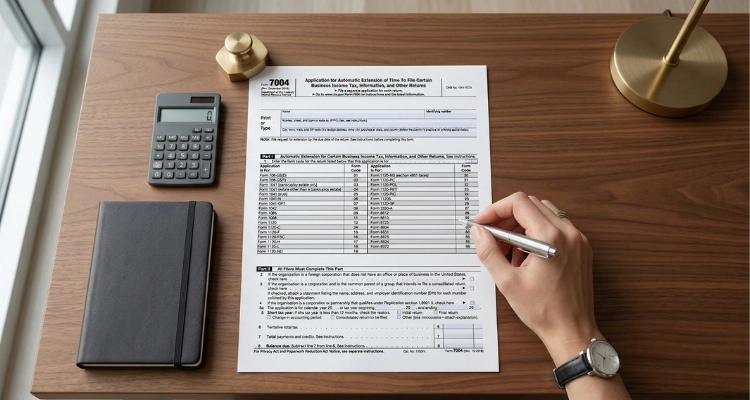
Is the tax deadline looming closer than your prepared documents? You aren’t alone. For many CPA firms, wealth managers, and growing businesses, the “standard” tax season often feels like a sprint toward a moving target. Whether you’re dealing with complex crypto accounting, delayed K-1s, or simply need more time to ensure 100% accuracy, IRS Form 7004 is your financial safety valve.
At Countsure, we understand that a tax extension isn’t a sign of disorganization; it’s a strategic move to ensure your financial reporting is bulletproof. This guide will walk you through everything you need to know about filing Form 7004 in 2026, from the specific form codes to the critical “extension to file vs. extension to pay” distinction.
Key Takeaways: Quick Facts for 2026 Filings
- Purpose: Form 7004 provides an automatic 6-month extension to file business income tax returns.
- The Golden Rule: An extension to file is NOT an extension to pay. Any tax liability must still be paid by the original deadline.
- 2026 Deadlines:
- March 16, 2026: Deadline for S-Corps (1120-S) and Partnerships (1065).
- April 15, 2026: Deadline for C-Corps (1120).
- Automatic Approval: If you file correctly and on time, the IRS grants the extension automatically no explanation required.
- How to File: Can be submitted via paper mail or electronically (highly recommended for faster processing).
What is the IRS Form 7004?
IRS Form 7004 is officially titled the “Application for Automatic Extension of Time to File Certain Business Income Tax, Information, and Other Returns.” Essentially, it is a request for more time to submit paperwork. While most businesses receive a standard 6-month extension, the duration can vary slightly based on your entity type. For example, in 2026, most C-corporations and partnerships receive a flat for 6 months.
Who Needs to File Form 7004?
This form is specifically for business entities. If you are a sole proprietor or a single-member LLC filing on a Schedule C, you actually need Form 4868 (the individual extension). However, Form 7004 is the go-to for:
- C-Corporations (Form 1120)
- S-Corporations (Form 1120-S)
- Partnerships (Form 1065)
- Multiple-Member LLCs (taxed as partnerships or corporations)
- Trusts and Estates (Form 1041)
The Primary Difference: Filing vs. Paying
The most common mistake businesses make is assuming the extension gives them six more months to write a check to the IRS.
It does not.
If you owe the IRS $50,000 in taxes, that $50,000 is still due by your original March or April deadline. Filing Form 7004 simply stops the Failure to File penalty, which is 5% of the unpaid taxes for each month (or part of a month) the return is late, capped at a maximum of 25% of the unpaid tax. If you don’t pay the tax due by the original deadline, you will still face the Failure to Pay penalty of 0.5% per month on the unpaid balance, also capped at 25% plus, interest that accrues daily from the original due date.
In other words, if you file late and pay late, both penalties can run simultaneously, making the financial consequences significantly worse than either one alone.
If you aren’t sure of your exact liability, estimate conservatively. It is better to overpay slightly and receive a refund than to underpay and face compounding interest charges.
Need Help Calculating Your 2026 Tax Liability?
Get accurate insights and expert guidance tailored to your financial situation with Countsure’s experienced tax professionals.
Step-by-Step: How to Fill Out Form 7004
Filing Form 7004 is surprisingly straightforward, but a single typo in your EIN or the wrong “Form Code” can result in a rejection.
Step 1: Gather Your Business Information
You will need your:
- Legal Business Name and Address
- Employer Identification Number (EIN)
- The specific IRS form you are extending (e.g., 1120, 1065)
Step 2: Identify the Correct Form Code (Part I)
Line 1 of Form 7004 asks for a “Form Code.” This is a two-digit number that corresponds to the tax return you are extending.
|
Business Type |
Tax Return Form |
7004 Form Code |
|
C-Corporation |
Form 1120 |
12 |
|
S-Corporation |
Form 1120-S |
25 |
|
Partnership |
Form 1065 |
09 |
|
Trust/Estate |
Form 1041 |
03 / 04 / 05 |
Form 1041 applies to both trusts and estates, but the correct 7004 code depends on the type:
- 03 – Bankruptcy estate
- 04 – Decedent’s estate
- 05 – Trust
Step 3: Complete Part II (General Information)
In this section, you will answer basic questions about your entity:
- Line 2: Check this box if your organization is a foreign corporation that does not have an office or place of business in the United States.
- Line 3: Enter the total tax liability for the tax year (estimate if the final amount is not yet available).
- Line 4: Check if you qualify under certain regulations (usually for taxpayers abroad).
- Line 5a/5b: Specify if you use a calendar year (ending Dec 31) or a fiscal year’s.
Step 4: Estimate Your Tax (Lines 6, 7, and 8)
- Line 6(Tentative Total Tax): Enter your best estimate of your total tax liability for the year.
- Line 7(Total Payments/Credits): Enter all amounts already paid toward this year’s tax liability.
- Line 8(Balance Due): Subtract Line 7 from Line 6. If the result is greater than zero, this is the amount you owe and must pay by the original deadline, not the extended deadline.
When is the Form 7004 Deadline in 2026?
Timing is everything. You must file Form 7004 on or before the original due date of your return not after. Even one day late means the extension is invalid.
- For Partnerships and S-Corps: The deadline is March 15. However, since March 15, 2026, falls on a Sunday, the deadline is pushed to Monday, March 16, 2026.
- For C-Corporations:
The deadline is Wednesday, April 15, 2026, with a 6-month extension available. - For Trusts & Estates (Form 1041):
The deadline is also Wednesday, April 15, 2026, but the extension period is 5.5 months, not 6 months.
|
Entity Type |
Original Deadline |
Extended Deadline (after filing Form 7004) |
|
Partnerships (Form 1065) |
March 16, 2026 |
September 15, 2026 |
|
S-Corporations (Form 1120-S) |
March 16, 2026 |
September 15, 2026 |
|
C-Corporations (Form 1120) |
April 15, 2026 |
October 15, 2026 |
|
Trusts & Estates (Form 1041) |
April 15, 2026 |
September 30, 2026 |
How to Submit Form 7004 to the IRS
There are two ways to file: the “Digital Way” and the “Paper Way.”
1. Electronic Filing (e-File)
This is the fastest and most reliable method. Most tax software and professional accountants (like the team at Countsure) use the IRS Modernized e-File (MeF) system. You typically receive an electronic acknowledgment within 24 hours confirming your extension has been recorded.
2. Filing by Mail
If you choose to mail a paper form, you must send it to the specific IRS service center for your region.
If you are paying by check, make it out to “United States Treasury” and include your EIN and “2025 Form 7004” in the memo line.
Why Modern Businesses Outsource This Process
Managing deadlines for multiple entities, ensuring the correct LSI keywords for compliance, and calculating precise 409A valuations or crypto gains is a massive burden for growing firms.
At Countsure, we don’t just “file forms.” We provide a scalable back-office engine for CPA firms and businesses.
- Hire an Offshore Tax Preparer: Save up to 50% on labor costs while maintaining US-grade quality.
- Audit Support: If the IRS comes knocking, we handle the documentation, correspondence, and response preparation on your behalf.
- QuickBooks/Xero Experts: Our QuickBooks and Xero experts ensure your books are clean, reconciled, and genuinely tax-ready well before any deadline
Common Mistakes to Avoid
- Wrong EIN: If your business name and EIN do not match the IRS database exactly, your extension will be rejected outright. This is one of the most common and entirely avoidable reasons for rejection.
- Missing the Deadline: Even a day late means the extension is invalid.
- Forgetting State Extensions: Filing a federal Form 7004 does not automatically extend your state tax return deadline. Every state has its own rules, some automatically honor the federal extension; some require a separate state-level extension form, and some require both.
- No Signature (on paper forms): But Know the Exception This is a common point of confusion.
Conclusion: Let Countsure Handle the Heavy Lifting
Filing Form 7004 is a vital tool for any business owner or CPA who needs extra time to ensure financial precision. While the form itself is simple, the strategy behind your tax liability and the coordination of multiple filings can be overwhelming.
Countsure is here to be your partner in growth. From AR/AP management to high-level financial reporting and offshore tax support, we provide the expertise you need to scale without the overhead. Don’t let tax deadlines disrupt your momentum.
Frequently Asked Questions
1. Does Form 7004 give me more time to pay my taxes?
No, Form 7004 only extends the deadline to file your paperwork. Any taxes you owe must still be paid by the original March or April deadline to avoid interest.
2. Is the approval for Form 7004 automatic?
Yes. As long as you fill out the form correctly, use the right form code, and submit it on time; the IRS grants the 6-month extension automatically without a signature.
3. What happens if I miss the Form 7004 deadline?
If you miss the deadline, you cannot file for an extension. You will likely face failure-to-file penalties, which are significantly higher than failure-to-pay penalties.
4. Can I file Form 7004 for my personal taxes?
No, Form 7004 is strictly for business entities and estates. Individuals and sole proprietors must use Form 4868 for their personal tax extensions.
5. How long is the extension provided by Form 7004?
For most businesses, including Partnerships and C-Corps, Form 7004 provides a 6-month extension. Some specific entities may have different timeframes, so check your form of code instructions.
6. Do I need to explain why I need an extension?
No, you do not need to provide any reason or excuse. The IRS allows businesses to request this time for any reason, provided the form is filed in timely.
7. Can I file Form 7004 electronically?
Yes, the IRS encourages e-filing for Form 7004. It is faster, more secure, and provides you with an immediate receipt of filing.
8. Do I need a separate Form 7004 for each business I own?
Yes. Every business entity with a unique EIN must file its own separate Form 7004 to receive an extension for that specific entity.