

APR for a US LLC Owned by an Indian Company: 5 Mismatches That Delay Filing
 Parth ShahPublished:November 3, 2026
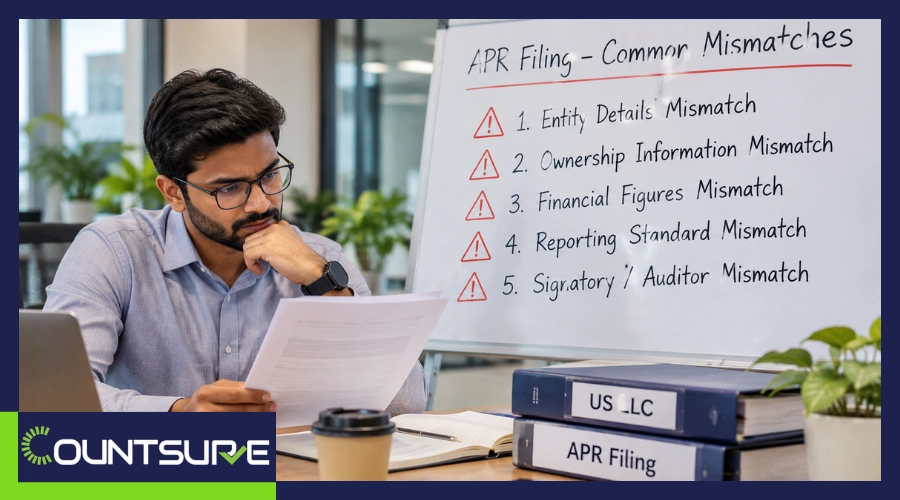
The short answer: The APR for a US LLC owned by an Indian company is due every year by December 31, like any other APR. Because the Indian parent controls a single-member LLC, the APR needs audited financial statements. The LLC’s US tax filing, a pro forma Form 1120 with Form 5472, has no balance sheet, so it cannot replace them. Most delays come from five mismatches between the LLC’s books and what the Indian parent reported to its bank.
Many Indian companies enter the US through a single-member LLC (limited liability company). It is quick to form, simple to run, and its US tax filing is light. But the APR for a US LLC is where that simplicity runs out. The APR, or Annual Performance Report, is the yearly report filed through your AD bank, the Indian bank that handles your foreign remittances.
An LLC is built differently from a corporation. It has no shares, its owners have capital accounts, and its tax filing says little about its finances. In our APR audits for US subsidiaries of Indian companies, LLCs produce more bank queries than corporations, and almost always for the same five reasons.
This guide explains each one in plain terms and shows how to fix it before your bank asks.
Key Takeaways
- The APR for a US LLC is due by December 31 each year, and a single-member LLC owned by the parent needs audited statements.
- The LLC’s pro forma Form 1120 with Form 5472 is a US tax filing with no balance sheet, so it cannot support the APR.
- An LLC records investment in a member’s capital account, not share capital, which must match what India reported.
- LLC distributions are not automatically dividends; any part that exceeds profit is a return of capital.
- The ODI rules need evidence of investment within six months of the remittance, and an LLC issues no share certificate.
- Any company the LLC owns is a step-down subsidiary that must be disclosed in the APR.
Does a US LLC Need to File an APR?
Yes. An Indian company that invests in a US LLC has made an overseas direct investment, and it must file an APR for that LLC every year by December 31. The LLC’s legal form does not change this. An LLC is treated like any other foreign company for the APR.
A single-member LLC also almost always needs an audit. The APR must rest on audited statements whenever the Indian investor controls the foreign company, and a sole owner controls its LLC by definition. Our guide to whether your US subsidiary needs an audit for the APR explains the control test in full.
Why Is an LLC Harder Than a US Corporation for the APR?
An LLC is harder because three things the APR relies on look different in an LLC. Corporations have shares, share capital and a full tax return with a balance sheet. A single-member LLC has none of these by default.
- No shares. Ownership sits in a membership interest set out in the operating agreement, not in a share register.
- Capital accounts, not share capital. The owner’s investment and profits are tracked in a member’s capital account.
- A light tax filing. A foreign-owned single-member LLC files a pro forma Form 1120 with Form 5472, which reports transactions but no balance sheet.
None of this is a problem in itself. It only becomes one when the LLC’s books and the Indian parent’s records describe the same money in different ways. The five mistakes below are where that happens.
Not sure your LLC's books are ready for an APR audit?
Mistake 1: Money From India Recorded as a Loan, Not Capital
The most common mismatch is money recorded as capital in India and as a loan in the LLC’s books. The Indian parent reports each remittance to its bank as equity or as debt. If the LLC’s bookkeeper records it the other way, the APR figures will not match the audited statements.
This often happens because LLC books are kept simply. A transfer from the parent lands in a “due to member” or “loan from owner” account by default, even when India reported it as a capital contribution.
A worked example: how one booking changes net worth
A Hyderabad-based IT services company owns 100% of a Delaware LLC. During calendar 2025, it sent the LLC $400,000 and reported the whole amount to its AD bank as equity. The LLC’s bookkeeper recorded $250,000 as a capital contribution and $150,000 as a loan from the parent. The LLC earned $60,000 and distributed $40,000 to the parent.
| Item | LLC books as kept | If all $400,000 is capital |
|---|---|---|
| Capital contributed | $250,000 | $400,000 |
| Add: 2025 profit | $60,000 | $60,000 |
| Less: distribution | ($40,000) | ($40,000) |
| Member's capital (net worth) | $270,000 | $420,000 |
| Loan from parent | $150,000 | None |
The two versions differ by $150,000 in net worth: $420,000 minus $270,000. The APR reports both the equity invested and the net worth, so this gap shows up on the first page the bank reads.
The fix: agree every remittance with the parent before the audit starts. Match each one to the bank advice and the parent’s ODI filing, then correct whichever side is wrong.
Mistake 2: Using the US Tax Return Instead of Financial Statements
A foreign-owned single-member LLC’s US tax filing cannot be used for the APR. For federal tax purposes, the IRS treats such an LLC as a corporation only for reporting its dealings with its owner. It files a pro forma Form 1120 carrying identifying details only, with Form 5472 attached to report transactions with the foreign owner.
That filing has no balance sheet, no net worth and no audit opinion, which are exactly what the APR needs. Our guide to the Form 5472 and pro forma Form 1120 connection explains what the filing does contain.
| What the APR needs | Pro forma 1120 with Form 5472 | Audited statements |
|---|---|---|
| Balance sheet and net worth | No | Yes |
| Profit or loss for the year | No | Yes |
| Transactions with the parent | Yes | Yes |
| Independent audit opinion | No | Yes |
The fix: keep full books for the LLC through the year, not just enough to file Form 5472. Our bookkeeping services for US companies keep the LLC’s ledger audit-ready, so the year-end close is quick.
Mistake 3: Calling LLC Payouts "Dividends"
An LLC does not pay dividends in the corporate sense. It makes distributions from the member’s capital account. The APR asks for dividends and other repatriation, so each distribution needs to be split correctly before it is reported.
The split is simple in principle. The part of a distribution that comes out of the year’s profit, or past profits, is a return on the investment, much like a dividend. Any part that exceeds accumulated profit is a return of the capital the parent put in. That second part can change how the investment itself is reported.
The fix: track profits and contributions separately inside the capital account. Then each distribution can be traced to one or the other, and your CA can report it correctly in the APR.
Mistake 4: Forgetting the Companies Your LLC Owns
If your US LLC owns another company, that company is a step-down subsidiary, and it must be disclosed in the APR. This is common when an LLC sets up a second LLC for a new product, property or state. The parent may not even know the second entity exists until the auditor asks.
The second company’s investment balance sits in the first LLC’s books, so the audit picks it up. The APR then has to list it, with its details, alongside the main LLC.
The fix: keep a short chart of every entity in the US group, with who owns what and when each was formed. Share it with your auditor and your CA at the start of each year.
Mistake 5: No Share Certificate to Show the Bank
An LLC issues no share certificate, but the bank still needs evidence of your investment. Regulation 9(1) of India’s Overseas Investment Regulations, 2022 requires “share certificates or any other relevant documents” within six months of the remittance. For an LLC, the “other relevant documents” do the work.
In practice, banks look for the documents that prove your membership interest:
- The operating agreement, naming the Indian company as sole member and showing its interest.
- A membership interest certificate or ledger, if the LLC issues one, updated for each contribution.
- The state formation documents, such as the certificate of formation, showing the LLC exists.
Our guide to the LLC operating agreement explains what that document should cover. Keep it current, because the bank will compare the ownership it shows with your APR.
Does your LLC have one of these five mismatches?
Book a 30-minute call with a US CPA. We will look at how your LLC records capital, loans and distributions, check its ownership documents, and tell you what to fix before the audit and the APR.
All Five Mismatches at a Glance
Here is a quick reference you can share with your finance team:
| Mismatch | What goes wrong | How to fix it |
|---|---|---|
| Loan vs capital | Net worth differs from India's records | Agree each remittance with the parent |
| Tax filing used as accounts | No balance sheet or opinion | Keep full books and get an audit |
| Payouts called dividends | Wrong repatriation figures | Split profit and capital in the account |
| Hidden step-down entities | Incomplete APR | Keep a group entity chart |
| No share certificate | Bank asks for proof of investment | Keep the operating agreement current |
Does It Help if the LLC Is Taxed as a Corporation?
It helps a little, but it does not remove the audit. An LLC can elect to be taxed as a corporation by filing IRS Form 8832. It then files a full Form 1120, which may include a balance sheet.
That return is still a tax filing prepared from the books, not audited financial statements. A controlled LLC still needs an audit for its APR, whatever its tax election. The election is a tax decision to make on its own merits, not an APR shortcut.
How Do You Get Your LLC Ready for the APR?
You get your LLC ready by fixing the books before the audit, not during it. These five steps cover it:
- Close the LLC’s books by February 28. Reconcile every bank account and record year-end items.
- Agree every remittance with the parent. Match each one to the bank advice and confirm capital or loan.
- Split the capital account. Track contributions, profits and distributions separately.
- List every entity in the US group. Include any company the LLC owns.
- Book the audit early. Then hand the audited figures to your CA for the APR filing with your AD bank.
If your Indian CA is unsure whether to audit the LLC directly, our guide on whether an Indian CA can audit a US company sets out how the work can be shared.
APR for US LLC FAQs
1. Does a single-member US LLC need an APR?
2. Can I use my LLC's Form 5472 for the APR?
3. Does a US LLC need an audit for the APR?
4. How do I show the bank my investment in an LLC?
5. Are LLC distributions the same as dividends for the APR?
6. What if my US LLC owns another LLC?
7. Does a dormant US LLC still need an APR?
8. Who can audit my US LLC for the APR?
Conclusion: Filing the APR for Your US LLC Without Delays
The APR for a US LLC is due every December 31, and a single-member LLC needs audited statements because the parent controls it. Its Form 5472 filing cannot stand in for them. The LLC form is simple, but its capital accounts, payouts and missing share certificates create mismatches that banks catch. Fix those five points before the audit, and the APR becomes a routine filing.
- Agree every remittance as capital or loan with the Indian parent.
- Keep full books for the LLC, not just enough for Form 5472.
- Split each distribution between profit and return of capital.
- Keep the operating agreement current as your proof of investment.
An LLC that is set up right takes no more effort at APR time than a corporation.
Ready to get your LLC's APR audit booked?

Parth Shah, Managing Director
(CPA-US, FCA, RV-S&FA, DISA)
Parth Shah who is head of Accounts and Book keeping has experience of more than 10 years. A Certified Public Accountant – US, fellow Chartered Accountant, Registered Valuer and Diploma in Information System Audit.