

W-2 vs 1099: What Is the Difference and Which One Applies to You?

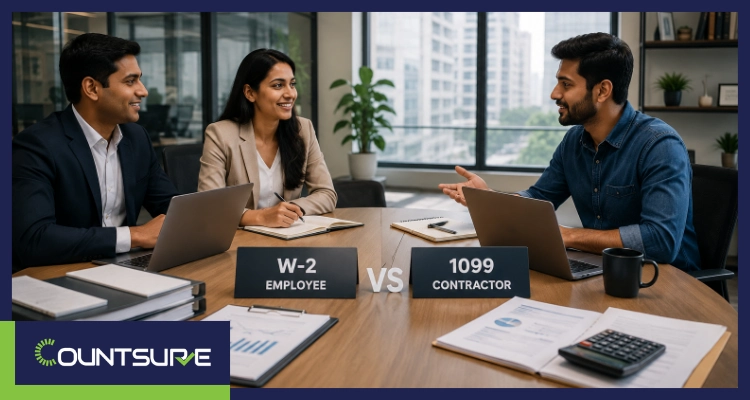
Whether you are a business owner deciding how to bring on new talent or a worker trying to understand your tax situation, the W-2 vs 1099 question comes up constantly. These two forms represent two fundamentally different working arrangements, and confusing them can lead to serious tax penalties, misclassification lawsuits, and unexpected costs for both sides.
The short answer: a W-2 is issued to employees whose income and payroll taxes are withheld by the employer, while a Form 1099-NEC is issued to independent contractors who are responsible for reporting and paying their own income and self-employment taxes.
At Countsure, we work with startups, small businesses, freelancers, and CPA firms across the US who deal with this exact question every tax season. This guide breaks down the full picture so you can make the right call.
Key Takeaways
- W-2 vs 1099 at a glance: A W-2 employee has taxes withheld by the employer; a 1099 contractor pays their own taxes directly to the IRS.
- Self-employment tax burden: 1099 contractors pay a 15.3% self-employment tax covering both the employee and employer share of Social Security and Medicare.
- Employer tax responsibilities: Businesses that hire W-2 employees must withhold federal income tax, Social Security, and Medicare, and pay the employer’s share of payroll taxes.
- IRS classification rules: The IRS uses behavioral control, financial control, and type-of-relationship tests to determine whether a worker is an employee or a contractor.
- Misclassification risks: Incorrectly classifying a W-2 employee as a 1099 contractor can result in back taxes, interest, and penalties for the business.
- Benefits gap: W-2 employees typically receive health insurance, retirement contributions, and paid leave. 1099 contractors receive none of these unless self-funded.
- Form deadlines matter: W-2 forms must be sent to employees by January 31. 1099-NEC forms must also go out by January 31 for contractors paid $600 or more.
- Hiring flexibility: 1099 contractors offer more flexibility and lower upfront cost, but W-2 employees often deliver more consistency and legal protection for ongoing roles.
What Is a W-2 Employee?
A W-2 employee is someone who works under an employer’s direct control and direction. The employer sets the schedule, provides the tools, defines the work processes, and handles payroll. At the end of each year, the employer furnishes a Form W-2 to the employee and files a copy with the Social Security Administration (SSA) by January 31. The W-2 summarizes total wages paid and all federal income tax, Social Security, and Medicare taxes withheld during the year. The SSA shares this data with the IRS for income tax purposes.
W-2 employees are covered by federal and state employment laws, which means they are entitled to protections such as minimum wage, overtime, workers’ compensation, and unemployment insurance.
How W-2 Payroll Taxes Work
When a business pays a W-2 employee, it does not just hand over the gross salary. The employer withholds:
- Federal income tax (based on the W-4 the employee files)
- State income tax (where applicable)
- 6.2% Social Security tax on wages up to the annual wage base
- 1.45% Medicare tax. An additional 0.9% Medicare tax (Additional Medicare Tax) applies to employee wages exceeding $200,000 in a calendar year, but it is withheld from the employee only.
The employer pays a matching 6.2% Social Security and 1.45% Medicare contribution from its own funds, plus FUTA (federal unemployment), SUTA (state unemployment), and workers’ compensation. Combined, these mandatory employer taxes typically add 10% to 12% on top of the gross salary before benefits, paid leave, or other overhead.
What Is a 1099 Contractor?
A 1099 contractor (also called an independent contractor or freelancer) is a self-employed individual who provides services to a business but is not on its payroll. The business does not control how the work is done, only the result. At the end of the year, if a business pays a contractor $2,000 or more for services during the calendar year (raised from $600 under the One Big Beautiful Bill Act, effective for payments made after December 31, 2025), it must issue Form 1099-NEC reporting the total amount paid. Note: For payments made during 2025 or earlier, the old $600 threshold still applies.
No taxes are withheld from contractor payments. The contractor is responsible for calculating and paying their own taxes, including both income tax and self-employment tax.
How 1099 Taxes Work for Independent Contractors
Self-employed contractors are required to pay:
- Self-employment tax of 15.3% on net earnings (covering both the employee and employer sides of Social Security and Medicare)
- Federal income tax based on their net profit
- Quarterly estimated taxes to avoid underpayment penalties
However, contractors can deduct legitimate business expenses such as a home office, equipment, software, and professional development from their taxable income, which can significantly reduce what they owe.
Confused about how to handle contractor payments and payroll tax obligations?
Our team at Countsure helps small businesses and CPA firms stay fully compliant year-round.
W-2 vs 1099: The Core Differences Explained
This table gives you a side-by-side view of the two worker classifications across the most important dimensions:
| Factor | W-2 Employee | 1099 Contractor |
| Who controls the work? | Employer has the right to control how, when, and where the work is done | Contractor controls the manner and means of the work; business controls only the result |
| Tax withholding | Employer withholds income, SS, Medicare & state income tax | No withholding; contractor pays directly |
| Self-employment tax | Not applicable | 15.3% on net earnings |
| Employer tax contribution | 7.65% matching payroll taxes | None required |
| Benefits eligibility | Health insurance, PTO, retirement | Not provided by the business |
| IRS form used | W-2 (wages and tax statement) | 1099-NEC (nonemployee compensation) |
| Form deadline | January 31 | January 31 |
| Expense deductions | Limited to unreimbursed job expenses | Broad business expenses deductions on Schedule C |
| Employment law protections | Yes (minimum wage, FMLA, workers’ comp) | Generally, no |
| Ongoing vs project-based | Typically ongoing, full or part-time | Typically project-based or short-term |
How Does the IRS Classify Workers? W-2 vs 1099 Rules
The IRS does not let businesses decide arbitrarily who gets a W-2 and who gets a 1099. Classification must be based on the actual working relationship. The IRS uses a three-part test to determine worker status.
1. Behavioral Control: Does the company control or have the right to control what the worker does and how they do their job? If yes, the worker is likely an employee.
2. Financial Control: Does the business control the economic aspects of the worker’s job, such as how the worker is paid, whether expenses are reimbursed, and who provides tools and supplies? Employees typically receive set wages, while contractors often invoice for work and supply their own equipment.
3. Type of Relationship: Are there written contracts, employee benefits, or is the relationship permanent rather than project-based? Permanent, benefits-receiving, long-term arrangements point to employment.
If all three factors suggest the business controls the worker, the IRS will classify them as an employee, regardless of what the contract says. This is an important point that many small businesses miss when building their workforce strategy.
If you are unsure how to classify your workers or need help setting up compliant payroll, our experts at Countsure can review your situation and guide you in the right direction.
What Are the Tax Implications of W-2 vs 1099?
The tax impact of each classification is significantly different for both the worker and the business.
Tax Obligations for W-2 Employees
From the employer side, hiring a W-2 employee means taking on payroll tax obligations. You must withhold the correct amounts from every paycheck, deposit those taxes on a schedule set by the IRS, and file quarterly and annual payroll tax returns. Many small businesses also need to pay federal and state unemployment insurance (FUTA and SUTA) on top of the standard payroll taxes.
For the employee, the experience is relatively straightforward. Federal and state income taxes, plus Social Security and Medicare contributions, are withheld from each paycheck before the employee receives it. At year-end they receive a W-2 that reports exactly what was earned and withheld.
Most W-2 employees file a standard Form 1040 without needing to track business expenses, since federal deductions for unreimbursed employee expenses are no longer available for most workers.
As businesses manage the complexity of filing on behalf of their W-2 workforce, understanding the broader landscape of 2026 tax law changes is equally important to ensure payroll processes remain compliant.
Tax Obligations for 1099 Contractors
From the business side, hiring a 1099 contractor is simpler on paper. You pay the agreed rate, keep records of payments, and send a 1099-NEC by January 31 if total payments for the year reach $2,000 or more (raised from $600 under the One Big Beautiful Bill Act, effective for payments made in 2026 and beyond). For payments made in 2025 or earlier, the $600 threshold still applies. You do not withhold taxes, pay employer-side payroll taxes, or provide benefits.
For the contractor, however, the tax picture is more complex. They must set aside a portion of every payment they receive to cover quarterly estimated taxes, track all deductible expenses, report business income and expenses on Schedule C, file Schedule C with their annual return, and pay the full 15.3% self-employment tax out of pocket.
The trade-off: contractors often charge higher hourly rates to compensate for these extra costs, which is something businesses should factor into the true cost comparison.
W-2 vs 1099: Employee Benefits and Protections
One of the clearest practical differences between the two classifications is what the worker receives beyond their base pay.
| Benefit or Protection | W-2 Employee | 1099 Contractor |
| Health insurance (employer-sponsored) | Often included | Not provided |
| Retirement plan (401k, SEP-IRA match) | Often included | Not provided |
| Paid time off (vacation, sick days) | Typically offered by employer policy | Not provided |
| Workers’ compensation | Yes, state-mandated for nearly all employers | Generally, not |
| Unemployment insurance | Eligible | Not eligible |
| FMLA protections | Yes (for qualifying employers) | No |
| Minimum wage and overtime laws | Protected under FLSA | Not protected |
| Non-disclosure and IP agreements | Standard | Negotiated separately |
For a worker, the benefit gap is a major consideration. A 1099 contractor who earns $80,000 per year may net less than a W-2 employee earning $65,000 once health insurance premiums; retirement savings, and self-employment taxes are factored in.
Managing payroll, employee benefits, and contractor payments across your team?
Countsure’s payroll and accounting services are built for growing businesses that want accuracy without the administrative headache.
What Happens If a Business Misclassifies a Worker?
Worker misclassification is one of the costliest mistakes a small business can make. The IRS and the Department of Labor actively audit this, and the penalties are steep.
If a business incorrectly treats a W-2 employee as a 1099 contractor, it can be held liable for:
- All unpaid employer payroll taxes (Social Security, Medicare, FUTA)
- The employee’s share of taxes that were never withheld
- Interest on unpaid taxes
- Penalties ranging from a percentage of unpaid taxes to substantial flat fines
- Back pay for benefits owed, in cases involving labor law violations
There is also legal exposure under state laws, many of which have stricter classification standards than the federal IRS rules. California’s ABC test, for example, creates a strong presumption of employment and places the burden on the business to prove otherwise.
Avoiding this risk starts with getting the classification right from day one. Reviewing common bookkeeping mistakes small businesses make can also help you build the financial hygiene habits that reduce audit exposure overall.
Should Your Business Hire a W-2 Employee or a 1099 Contractor?
This is ultimately a strategic decision that depends on the nature of the work, your budget, and your long-term goals.
Choose a W-2 employee when:
- The role is ongoing and requires consistent availability
- You need to control how and when work is performed
- The work requires direction and control over how, when, and where it’s performed
- The position involves access to sensitive client data or systems
- You want to build long-term institutional knowledge within the team
- The role requires attendance, specific hours, or physical presence
Choose a 1099 contractor when:
- You need specialized skills for a one-time project
- The work is project-based with a defined scope and end date
- You want flexibility to scale up or down without long-term commitments
- The contractor provides similar services to multiple clients
- Speed and flexibility in deploying specialized expertise are the primary factors
Many growing businesses use a hybrid model, with a small core W-2 team and a network of 1099 contractors for specialized, project-based work. This approach works well as long as every classification is defensible under IRS rules.
Whether you are growing your team with employees or building a contractor network, our team at Countsure can help you set up payroll, manage tax compliance, and avoid costly misclassification errors.
How to File W-2 and 1099 Forms Correctly
Filing these forms correctly and on time is non-negotiable.
For W-2 Forms:
- Employers must send Copy B to employees by January 31
- Copy A must be filed with the Social Security Administration by January 31 (if filing electronically)
- Errors on W-2 forms can be corrected using Form W-2c
For 1099-NEC Forms:
- Businesses must send Copy B to contractors by January 31
- Copy A must be filed with the Social Security Administration by January 31.
- Per OBBBA §70433, the threshold is now $2,000 for payments made in 2026 and later.
- Use Form 1099-MISC for rent, royalties, and other types of payments not covered by the NEC form
Keeping accurate payment records throughout the year is the most important step. A last-minute scramble in January to track down contractor payment totals is a common and avoidable problem. Solid bookkeeping processes, ideally reviewed quarterly, eliminate the stress.
A structured review of how to handle tax season outsourcing for CPA firms can also help accounting professionals manage their W-2 and 1099 filing workloads more efficiently when volume peaks.
Wrapping It Up: Know Your Classification Before You Hire
The difference between W-2 and 1099 isn’t just a paperwork distinction; it shapes tax obligations, legal responsibilities, worker protections, and real costs on both sides. It determines tax obligations, legal responsibilities, worker protections, and real costs on both sides of the arrangement. Getting it wrong is not just a paperwork inconvenience; it is a financial and legal risk that can follow a business for years.
The safest approach is to understand the IRS classification rules, document your working arrangements clearly, and ensure your payroll and contractor payment processes are set up correctly from the start.
Countsure works with businesses at every stage, from first hire to multi-state payroll, helping them navigate exactly these kinds of compliance decisions with confidence. If you have questions about worker classification, payroll tax responsibilities, or how to handle 1099 and W-2 filing correctly, get in touch with our team today and we will help you get it right.
Frequently Asked Questions
1. Can a worker be both a W-2 employee and a 1099 contractor for the same company?
Yes, this is possible but uncommon. An example would be a salaried employee who also does separate freelance project work outside their regular role. Each arrangement must be legitimate and clearly documented to satisfy IRS scrutiny.
2. What is the 1099-NEC form used for?
The 1099-NEC (Nonemployee Compensation) form reports payments made to independent contractors. If you pay a contractor $2,000 or more during 2026 or later, you are required to issue this form (raised from $600 under the One Big Beautiful Bill Act, effective for payments made after December 31, 2025). For payments made in 2025 or earlier, the $600 threshold still applies; you are required to issue this form by January 31. It replaced Box 7 of the older 1099-MISC form for contractor income reporting.
3. Who pays more in taxes, a W-2 employee or a 1099 contractor?
In most cases, a 1099 contractor carries a higher total tax burden because they pay the full 15.3% self-employment tax, covering both the employee and employer portions of Social Security and Medicare. W-2 employees only pay 7.65%, with the employer covering the other half.
4. Can a business choose to give someone a 1099 instead of a W-2 to save money?
No. Classification must reflect the actual working relationship as defined by the IRS. Calling someone a contractor simply to avoid payroll taxes is illegal and can result in significant back taxes, penalties, and interest.
5. Do 1099 contractors need to pay quarterly taxes?
Yes. Independent contractors who expect to owe $1,000 or more in taxes for the year are required to pay estimated quarterly taxes to the IRS. Failing to do so results in underpayment penalties even if the full amount is paid at year-end.
6. What is the deadline for filing W-2 and 1099 forms?
Both W-2 and 1099-NEC forms must be sent to workers and filed with the IRS by January 31 of the year following the tax year. For example, forms covering the 2025 tax year must be distributed and filed by January 31, 2026.
7. What records should a business keep supporting worker classification?
Businesses should retain contracts, invoices, communication records, project scopes, and any documentation showing that a contractor sets up their own schedule and methods. For W-2 employees, keep onboarding paperwork, W-4 forms, time records, and payroll tax filings. The IRS may look back for several years in an audit.
8. What should I do if I receive the wrong form from my employer?
If you believe you were issued a 1099 when you should have received a W-2, you can file IRS Form SS-8 to have the IRS determine your worker classification. You can also report any unreported income using Form 8919 to pay only your share of Social Security and Medicare taxes while the classification dispute is resolved.
Read More:
- 1040 vs 1099 Forms What’s the Difference
- Secure Tax Season Outsourcing: A Strategic Guide for CPA Firm Capacity & Compliance
- Outsourcing Accounting for Startups & CPA Firms: A Complete Guide
- USA Company Registration from India: Complete Guide to Legal, Tax, FEMA, Banking & Compliance Challenges (2026)

Parth Shah, Managing Director
(CPA-US, FCA, RV-S&FA, DISA)
Parth Shah who is head of Accounts and Book keeping has experience of more than 10 years. A Certified Public Accountant – US, fellow Chartered Accountant, Registered Valuer and Diploma in Information System Audit.