

● Entity & Tax Strategy · CPA-Led
S Corp vs. C Corp:
Same Entity, Two Tax Worlds
They aren’t two different companies. They’re the same corporation taxed under two different chapters of the tax code – and choosing the right one shapes everything from your tax bill to how you raise money.
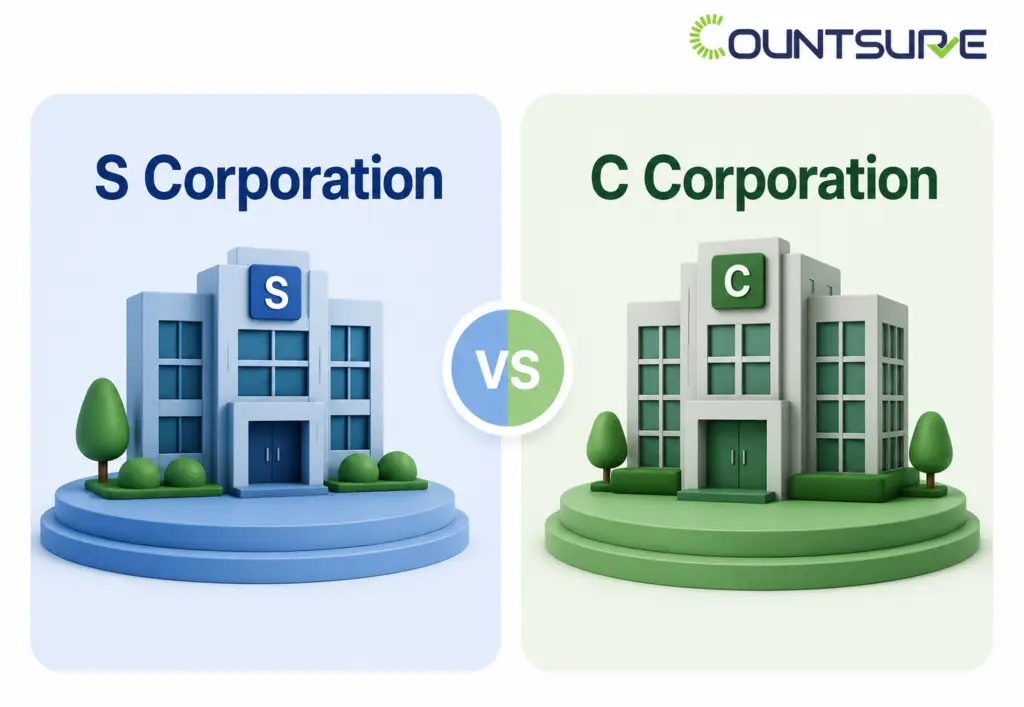
S
S Corporation
Subchapter S · elected
Profit passes through and is taxed once, on the owners' returns - in exchange for strict ownership limits.
✓ Single layer of tax (pass-through)
✓ Max 100 U.S. shareholders
✓ One class of stock · Form 1120-S
VS
C
C Corporation
Subchapter C · default
Pays its own tax and shareholders pay again on dividends - but with no limits on who can own it.
✓ Unlimited shareholders, any owner
✓ Multiple stock classes · VC/IPO-ready
✓ Double taxation · Form 1120
Here’s the part that trips up almost every founder: an S corp and a C corp are not two different kinds of company. They’re the same legal entity – a corporation formed under state law – taxed under two different chapters of the Internal Revenue Code. The letters come straight from those chapters: Subchapter C and Subchapter S. So the real question is rarely “which company should I form?” It’s “how do I want that corporation taxed?” If you’re one step earlier in the decision, our guide to choosing between an LLC and a corporation is the better place to start.
The short answer: A C corporation is the default – it pays its own income tax on profit, and shareholders pay again on dividends (the “double taxation” you’ve heard about). An S corporation elects pass-through treatment by filing Form 2553, so profit is taxed only once, on the owners’ returns – but it accepts strict limits: no more than 100 shareholders, only U.S. individuals and certain trusts and estates as owners, and a single class of stock. Neither is “better”; the right answer depends on how you pay yourself, whether you’ll raise outside capital, and how much profit you keep in the business.
● Key takeaways
What you need to know?
- "S" and "C" are tax elections, not separate business types - you form one corporation, then choose how it's taxed.
- A C corp is taxed at the entity level and again on dividends; an S corp passes profit through and is taxed once.
- S corps are capped at 100 shareholders, must be owned by U.S. individuals or eligible trusts, and can have only one class of stock.
- C corps have no ownership limits and can issue preferred and multiple share classes - which is why venture and IPO paths run through them.
- You elect S status with Form 2553; do nothing and your corporation is a C corp by default.
First, the thing most people get wrong
When you file your Articles of Incorporation with the state, you create a corporation – full stop. The state doesn’t know or care whether you’ll be an “S corp” or a “C corp,” because that distinction is purely a federal tax matter. Unless you take further step, the IRS treats your new corporation as a C corporation and taxes it under Subchapter C.
To be taxed as an S corporation instead, the corporation files Form 2553 (Election by a Small Business Corporation) with the IRS, signed by every shareholder, and must meet all of Subchapter S’s eligibility rules. That’s the whole mechanism. Same entity, same liability shield, same Articles of Incorporation – one form and a set of restrictions separate the two tax worlds. You can read the deeper detail on our C corporation and S corporation pages.
What the two actually share
Because an S corp and a C corp are the same underlying entity, most of what you think of as “being a corporation” is identical on both sides. Clear these off the table first, so the decision comes down to the handful of things that genuinely differ.
Limited liability
Shareholders aren’t personally on the hook for business debts either way.
Separate legal entity
The corporation exists in its own right, created by a state filing.
Same formation documents
Articles of Incorporation are filed with the state regardless of the tax election.
Same governance & formalities
Shareholders, a board, officers, bylaws, meetings, a registered agent, and annual filings apply to both.
Strip all of that away and only a few things are left standing: how you’re taxed, who can own the company, what stock you can issue, and how easily you can raise money. Those are the whole ballgame.
Not sure which election fits your plans?
Our CPA team walks founders through the S-vs-C decision every week – factoring in how you pay yourself, your investors, and your growth path.
How each one is taxed - the heart of the decision
This is where the two structures part ways, so it’s worth being precise.
C corp: taxed twice, but flexible
A C corp is a separate taxpayer. It files Form 1120 and pays corporate income tax on its profit. When it distributes what’s left as dividends, shareholders pay tax again on their personal returns. The same dollar is taxed at two levels – the corporation and the individual.
S corp: taxed once, straight through
An S corp files Form 1120-S, but that return is informational – the entity generally pays no federal income tax. Profits and losses pass through on a Schedule K-1 to the owners’ personal returns, where the tax is actually paid. One layer, not two.
HYPOTHETICAL ILLUSTRATION
All figures here are hypothetical and for illustration only – your real numbers depend on rates, deductions, your state, and how you pay yourself. Say a corporation earns $200,000 of profit and the owner wants to take it all out:
As a C corp
The company pays corporate tax on the $200,000, then the owner pays personal tax again on the dividend from what remains – two bites at the same apple.
As an S corp
The $200,000 passes through to the owner’s personal return and is taxed once, at individual rates – no separate corporate-level tax on that profit.
For a business that distributes most of its profit to a small group of owners, the single layer of an S corp is often the cheaper path. For one that reinvests heavily, plans to raise venture capital, or retains earnings inside the company, the C corp’s flexibility can outweigh the second layer of tax. This is exactly why entity choice sits upstream of every other tax question – we map that out across income, payroll, sales, and more in our guide to the main types of business taxes.
● The takeaway
One choice, a chain of consequences
The S-vs-C election looks like a single checkbox, but it quietly sets your tax bill, who can invest, what stock you can issue, and how easily owners can come and go. That’s why it pays to decide deliberately rather than default into it.
The table below lays the two structures side by side so you can see, at a glance, exactly where they diverge – and which one your situation points toward.
S corp vs. C corp, side by side
Even when the tax math favors an S corp, the eligibility rules can take it off the table. Read this as a filter, not just a list.
| Factor | C Corporation | S Corporation |
|---|---|---|
| Tax treatment | Taxed at the entity level; profit taxed again as dividends (double taxation) | Pass-through; profit flows to owners' returns, taxed once |
| Federal return | Form 1120 | Form 1120-S + Schedule K-1 |
| How you elect it | Default - no election needed | Elect by filing Form 2553 with the IRS |
| Shareholder cap | Unlimited | No more than 100 (families can count as one) |
| Who can own shares | Anyone - individuals, entities, and non-U.S. persons | U.S. citizens/residents, certain trusts and estates only |
| Classes of stock | Multiple (common, preferred, etc.) | One economic class (voting differences allowed) |
| Raising capital / VC | Investor- and IPO-friendly | Restricted - most VC and PE funds are ineligible owners |
| Loss pass-through | No - losses stay at the entity | Yes - losses can offset owners' other income (with limits) |
If you need preferred stock, plan to raise a venture round, or expect a non-U.S. or entity owner on the cap table, Subchapter S is usually out – and a C corp is the practical answer. If ownership is a small group of U.S. individuals sharing profit proportionally, the S corp’s single layer of tax is often the win.
The advantages and trade-offs
S corporation
Where it shines
● One layer of tax. Distributed profit is taxed only on the owners’ returns.
● Losses can flow to you. They can offset an owner’s other income (within limits) – valuable in lean years.
Where it constrains you
● Hard 100-shareholder cap Can’t go public; limited equity reach.
● Narrow list of owners. U.S. individuals/certain trusts only – shuts out most VC and PE.
● One class of stock. No preferred shares or special distribution rights.
● Transfer restrictions. Most limit share transfers to protect the election – clunkier exits
C corporation
Where it shines
● No ownership limits. Unlimited shareholders – individuals, companies, non-U.S. investors.
● Multiple stock classes. Issue preferred and different share classes investors want.
● Built for raising capital. The structure venture funds expect and the one you need for an IPO.
Where it constrains you
● Double taxation. The defining drawback – profit is taxed at the corporate level and again on dividends.
● Making the call
How to choose: signals that point each way
There’s no universal answer – it depends on your ownership, payout plans, and growth path. In practice, a few signals tend to settle it.
Lean toward an S corp if…
- Your owners are a small group of U.S. individuals.
- You plan to distribute most of the profit rather than retain it.
- You don't expect to issue preferred stock or take institutional investment.
- Pass-through lowers the owners' overall tax, or early losses would help on personal returns.
Lean toward a C corp if…
- You plan to raise venture capital or eventually go public.
- You want to reinvest and retain earnings inside the company.
- You need multiple classes of stock or freely transferable shares.
- Your cap table will include entities or non-U.S. owners.
Once the tax election is settled, the next practical questions are usually where to incorporate and how to set up cleanly – our notes on
choosing the best state to incorporate and the benefits of formal incorporation pick up from there.
● Why CountSure
Entity decisions, made with confidence
We help founders and owners pick the right election and keep it compliant year after year – grounded in how the tax rules actually work, not generic advice.
US CPA-led
Advice grounded in current IRS rules and federal tax code - not generic templates.
Filing done right
From the Form 2553 election to Form 1120 or 1120-S returns, handled cleanly and on time.
The whole lifecycle
From incorporation and the S-election to conversions, financing, and eventual exit.
Clear, current guidance
Plain-English answers that account for how tax rules actually change year to year.
● FAQ
S corp vs. C corp: common questions
Neither is universally better – it depends on your situation. For a small, closely held business that distributes most of its profit to a few U.S. owners, an S corp’s single layer of tax is often cheaper. For a company planning to raise venture capital, retain earnings, or go public, a C corp’s flexibility usually wins despite the double taxation.
Taxation. A C corp pays income tax at the corporate level and shareholders pay again on dividends (double taxation). An S corp passes profit through to owners’ personal returns, where it’s taxed once. Beyond tax, S corps face ownership and stock-class limits that C corps don’t.
Yes. An LLC can elect to be taxed as either an S corp or a C corp by filing the right election with the IRS, without changing its legal form. Many small businesses form an LLC and elect S-corp taxation for the pass-through treatment. The election changes how the LLC is taxed, not what it legally is.
First form a corporation (or LLC) by filing with your state. Then file IRS Form 2553, signed by all shareholders, within the required window to elect S-corp taxation – and make sure you meet every eligibility rule. If you never make the election, the IRS taxes your corporation as a C corp by default.
Subchapter S limits ownership to U.S. individuals and certain trusts and estates, and allows only one class of stock. Most venture and private-equity funds are partnerships or entities that aren’t eligible S-corp shareholders, and they typically want preferred stock – which an S corp can’t issue. That’s why VC-backed companies are almost always C corps.
Often, yes – a corporation that meets the eligibility rules can elect S status by filing Form 2553, and an S corp can revoke its election to become a C corp. Both directions carry timing rules and potential tax consequences, so the switch is worth planning with a professional rather than doing on the fly.
Get Started
Choosing between an S corp and a C corp? Start with the right advice.
CountSure helps founders and small-business owners pick the entity election that fits their ownership, payout plans, and growth path – and keeps the filings that follow clean, compliant, and on time.
- Free 30-minute consultation with a CPA
- Fixed-fee, fully transparent pricing
- 100% remote - no travel or visa required