

Dormant US Subsidiary Audit Services for APR
RBI gives no APR exemption to a US company just because it is inactive. If your Indian company controls it, every APR needs audited financials, so we audit quiet US subsidiaries on a fixed fee and keep your 31 December filing on time.
Your US company may be quiet, but RBI still expects audited accounts every year. We audit inactive US subsidiaries on a fixed fee, so your APR goes in on time.
A dormant US subsidiary audit is the annual audit of a US company with little or no activity, prepared so its Indian parent can file the Annual Performance Report (APR). Under the FEMA (Overseas Investment) Regulations, 2022, the APR is due by 31 December each year and must be based on audited financial statements. Zero revenue does not change that, and our APR audit services cover inactive subsidiaries too.
The usual mistake is assuming a quiet company needs no audit. The parent sends management-signed accounts to its authorized dealer (AD) bank, the bank sends them back, and 31 December passes while the parent is still looking for an auditor.
Your AD Bank Returned Unaudited Accounts?
Tell us when your US company was formed and the last year you filed an APR, and we will scope the audit.
Is There a Dormant Subsidiary APR Exemption? No
RBI does not treat “dormant” as a reporting category. The Overseas Investment Regulations remove the APR in only two situations:
- The Indian investor holds less than 10% of the equity, has no control, and has no financial commitment beyond that equity, such as a loan or guarantee.
- The foreign entity is under liquidation.
A non-operational foreign subsidiary APR is still an APR. If your Indian company controls the US entity, the filing runs every year until it is wound up.
Why "The US Doesn't Require an Audit" Doesn't Work
US law does not require a private company to be audited. The regulations allow unaudited, CA-certified accounts only when two conditions are both met: the host country does not mandate an audit, and the Indian investor does not control the foreign entity. A parent with a wholly owned US company set up from India meets the first condition and fails the second, so audited statements are required.
When You Genuinely Don't Need an APR Audit?
If the US company will never be revived, closing it is often cheaper than yearly audits, since APR reporting stops once it is under liquidation. We will tell you on the first call if that fits.
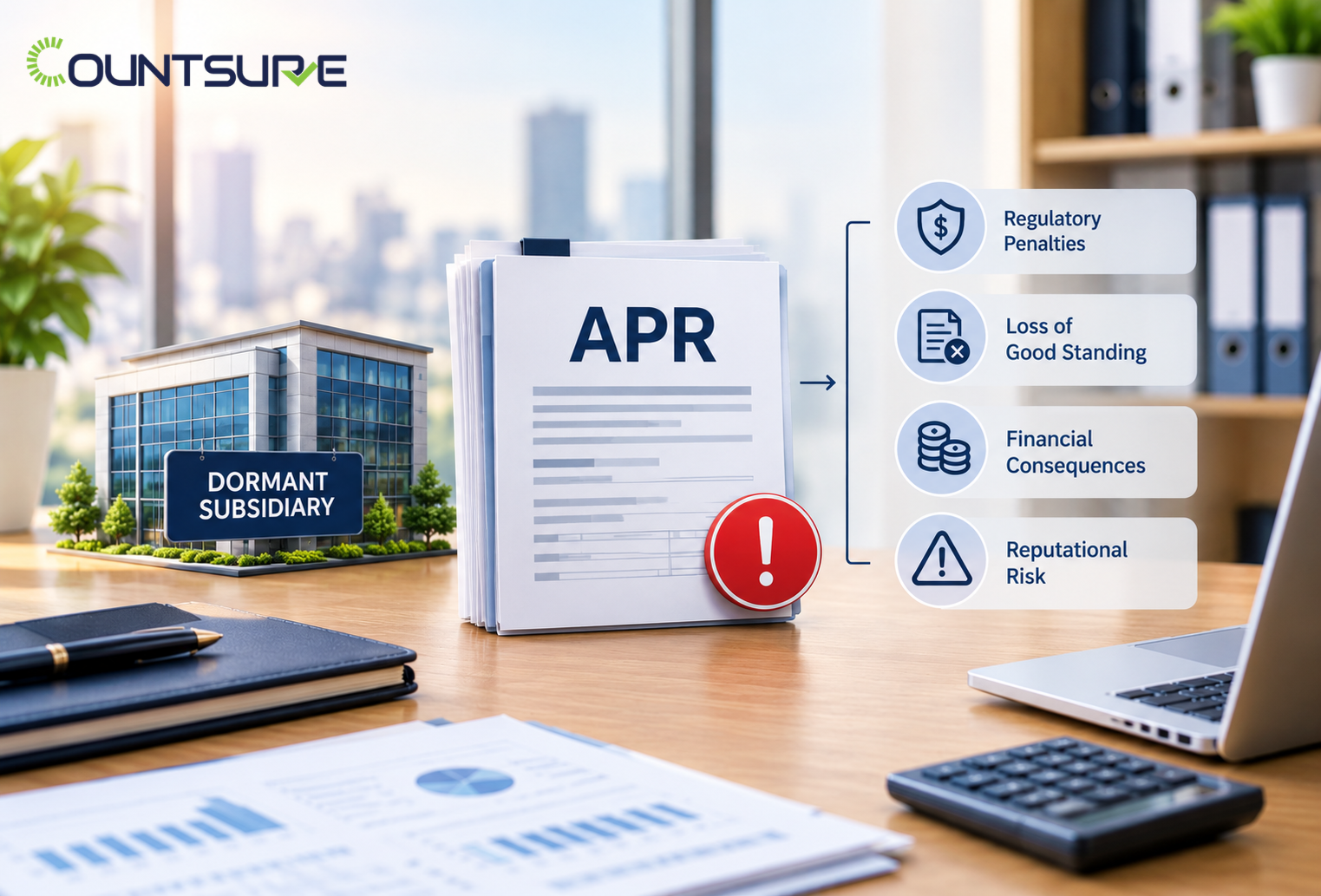
What Happens If You Skip the APR for a Dormant Subsidiary?
Late submission fee: RBI’s A.P. (DIR Series) Circular No. 16 of 30 September 2022 sets a fee of ₹7,500 for each delayed APR. The fee route is available only for up to three years from the due date.
A frozen investment: until the delay is regularized, the parent cannot make any further financial commitment to the US entity or transfer the investment.
Stacked years: each missed year needs its own audit and its own APR. A company that sat quiet for three years arrives with three audits due at once.
Missed APRs for More Than One Year?
Send us the years outstanding and your bank statements, and we will plan the catch-up audits in order.
What an Audit for an Inactive US Company Covers?
An audit for an inactive US company is small, but it follows the same AICPA auditing standards. We typically test:
A bank confirmation, or evidence that no US bank account exists.
Amounts owed to or by the parent, agreed to the parent's own books.
Carried forward correctly from the prior year.
Issued shares agreed to the ODI remittances recorded in India.
State franchise tax, annual report fees, and registered agent charges.
Whether the Form 1120, and Form 5472 where required, were filed for the year.
The Intercompany Mismatch That Holds Up Most APRs
Illustrative case: the parent pays the US company’s Delaware franchise tax directly from India and records a receivable from the subsidiary. The subsidiary’s books show nothing, because the money never passed through its account. The two balances disagree and the APR figures will not reconcile. We agree the correcting entries before the report is drafted.
What We Need From You to Start?
- Certificate of incorporation, share certificates, and prior-year APR if any
- US bank statements for the year, or confirmation that no account exists
- Form ODI and remittance records from your AD bank
- The parent's ledger account for the US subsidiary
- The year's Form 1120. If it was never filed, our US business tax filing team can bring it current.
Why Indian Companies Choose CountSure for US Subsidiary APRs
01
CPA-led sign-off
CountSure is a US-based CPA firm. Every audit is performed under AICPA professional standards and signed off by a licensed CPA.
02
Senior review on every file
A second reviewer checks the workpapers before any report is issued.
03
Fixed fee, agreed upfront
The fee depends on your records and years due, and is quoted before work starts.
04
India side coordinated
Indian chartered accountants certify the APR and file it with your bank, and we work with them directly.
Our Dormant Subsidiary Audit Process
1. Scoping call
We confirm whether an APR is required and for which years.
2. Document request
A short list built for an inactive company.
3. Fieldwork and confirmations
Bank, intercompany, and capital balances tested.
4. Draft financial statements
You and your Indian CA review them before anything is signed.
5. Signed audit report
Issued within 8 to 10 days per audit year once records are complete.
6. Next-year readiness
A checklist so next year’s audit starts well before 31 December.
Dormant US Subsidiary Audit FAQs
Is an APR required for a dormant or non-operational foreign subsidiary?
Yes. The FEMA (Overseas Investment) Regulations, 2022 exempt only entities under liquidation and stakes below 10% held without control or other financial commitment. A dormant subsidiary controlled by an Indian parent must file an APR every year.
Can I file the APR with unaudited accounts because the US doesn't require an audit?
Only if your Indian entity does not control the US company. CA-certified unaudited accounts are allowed when the host country does not mandate an audit and the investor lacks control. A wholly owned subsidiary needs audited statements.
Who can audit a US subsidiary for APR purposes?
A licensed US CPA firm can audit the US entity under AICPA auditing standards. The APR itself is then certified in India by the Indian entity’s statutory auditor or a chartered accountant.
We missed APRs for several years. Can the audits be done together?
Yes. Each year needs its own report, but we audit the years in sequence in one engagement, carrying each closing balance forward.
Does a dormant US company still have to file a US tax return?
Yes. A US corporation files Form 1120 every year, even with no income. A foreign-owned corporation also attaches Form 5472 when it had reportable transactions with its parent.
Would dissolving the US company stop the APR requirement?
Yes. Once the entity is under liquidation, APR reporting stops. The closure must also be reported to your AD bank.
Get Your Quiet US Company APR-Ready
Tell us your subsidiary’s formation year and last APR filed, and we will scope the dormant US subsidiary audit and quote a fixed fee.