

Bookkeeper vs. Accountant Your Complete Guide to Financial Professionals

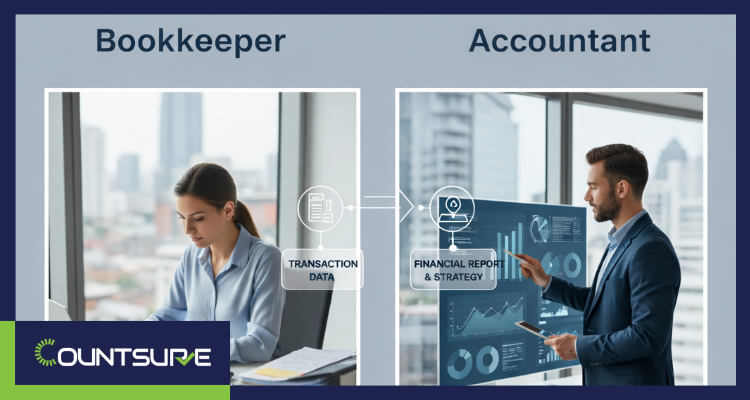
The core difference between a bookkeeper and an accountant is their focus: a bookkeeper handles the day-to-day recording of your financial transactions, while an accountant takes that data to provide high-level analysis, strategy, and complex tax compliance.
For your small or medium business (SME), this isn’t just a difference in titles – it’s a difference in function, cost, and the strategic value you receive. Knowing when to hire each is most important for financial health and growth.
At Countsure, we help businesses across industries like E-commerce, Real Estate, and Startups connect with the right financial expertise, from daily Bookkeeping/Business Management to strategic Virtual CFO services. This guide explains exactly what each professional does and how they work together to secure your financial future.Bookkeeping vs. Accounting: Understanding the Core Differences
The terms “bookkeeping” and “accounting” are often used interchangeably, but they represent two sequential stages of your financial management.What is Bookkeeping?
Bookkeeping is the administrative process of daily financial record keeping. It is the systematic and precise recording of every financial transaction “money coming in and money going out” into software like QuickBooks or Xero.- Primary Goal: To ensure the complete and accurate capture of all business financial activity.
- Time Focus: Historical and present-day transactions.
- Role Type: Transactional and clerical.
What is Accounting?
Accounting is the high-level process of summarizing, analyzing, interpreting, and reporting the financial data gathered by a bookkeeper. It uses those detailed records to paint a picture of the company’s financial health.- Primary Goal: To provide strategic financial insights for informed business decision-making and compliance.
- Time Focus: Present health, future planning, and forecasting.
- Role Type: Analytical, strategic, and advisory.
What Does a Bookkeeper Actually Do?
A bookkeeper is the dedicated custodian of your financial records. Their primary focus is to maintain an excellent and up-to-date general leader. This is a vital service for any growing SME or Startup.Key Bookkeeper Responsibilities:
| Area | Bookkeeper’s Responsibilities (The Daily & Monthly Tasks) |
|---|---|
| Transaction Recording | Accurately recording sales, receipts, expenses, and payments. |
| General Ledger Management | Posting debits and credits to ensure the ledger is balanced. |
| Accounts Management | Handling Accounts Payable (AP) management (paying bills) and Accounts Receivable (AR) management (invoicing clients and chasing late payments). |
| Reconciliation | Performing monthly bank and credit card reconciliations to ensure the business’s records match the financial institution’s statements. |
| Basic Reporting | Generating simple reports like the Profit & Loss statement and Balance Sheet. |
| Payroll | Managing the complete payroll service, including paychecks and associated tax withholding. |
A bookkeeper makes sure that when an accountant (or you) needs a number, it’s correct, up-to-date, and easy to find within your QuickBooks Accounting or Xero Accounting software.
A bookkeeper’s main function is to ensure daily financial record keeping is accurate, organized, and complete, preparing the raw data needed for higher-level analysis.
While a bookkeeper deals with recording transactions, only a qualified CPA or accountant can legally sign off on audited financial statements, represent you before the IRS, or provide detailed Tax Advisory Services.
What Does an Accountant Do?
An accountant, particularly a Certified Public Accountant (CPA), is your strategic financial advisor. They interpret the bookkeeper’s clean data to provide guidance on compliance, strategy, and profitability.Key Accountant Responsibilities:
| Area | Accountant’s Responsibilities (The Quarterly & Annual Strategy) |
|---|---|
| Analysis & Reporting | Reviewing financial statements and interpreting performance, cash flow, and financial trends. |
| Tax Services | Providing Business Tax Services and Tax Advisory Services, including tax planning and preparing/filing annual tax returns. |
| Audit & Assurance | Conducting internal audits, coordinating with external auditors, and offering Audit & Assurance services like SOC 1 / SOC 2. |
| Forecasting & Planning | Creating detailed budgets, financial forecasts, and cash flow projections for strategic decision-making. |
| Complex Financial Tasks | Handling adjusting entries, complex valuations for mergers/acquisitions, and ensuring advanced financial compliance. |
| Strategic Guidance | Providing high-level advisory support, often as a Virtual CFO or dedicated financial strategist. |
Bookkeeper vs. Accountant: A Quick Comparison Table
Choosing the right professional depends on your needs. Use this table as a quick reference to compare the core functions, focus, and cost of each role.| Feature | Bookkeeper | Accountant (Often CPA) |
|---|---|---|
| Main Function | Records day-to-day transactions and manages the ledger. | Analyzes financial statements, interprets data, and provides strategy. |
| Key Focus | Accuracy of historical data; daily financial record keeping. | Financial insight, strategic guidance, and tax planning. |
| Typical Services | Accounts Payable/Receivable, Reconciliation, Payroll, QuickBooks Accounting. | Financial Statements, Reporting, Tax Filing, Audits, Valuation, Virtual CFO. |
| Required Credential | Usually none required (may have certification); focuses on technical skills. | Typically requires a bachelor’s degree and often a CPA license. |
| Level of Advice | Clerical and administrative. | High-level, strategic, and compliance focused. |
| Best For | Maintaining a strong financial foundation; high transaction volume. | Business growth, complex structures, tax optimization. |
When to Hire a bookkeeper vs. When to Hire an Accountant
For small and medium businesses, the question isn’t usually if you need help, but when and which professional to hire first.
When to Hire a Bookkeeper (Your Financial Foundation)
You should prioritize an outsourced bookkeeping service when:
- You’re spending too much time on manual data entry. If you’re stuck in bills, invoices, and bank reconciliations, a bookkeeper will free up your time for revenue-generating activities.
- Your daily finances are becoming disorganized. You need an expert to manage your accounts payable and receivable and keep your general ledger immaculate.
- You need cost-effective support. Bookkeepers generally charge less than accountants, making them the ideal first hire for foundational financial management.
For new businesses, especially Startups or E-commerce companies with high transaction volumes, outsourced bookkeeping provides immediate, high-value organization.
When to Hire an Accountant (Your Financial Future)
You need to bring in an accountant or CPA when your needs evolve from basic record-keeping to strategic guidance:
- Your business is growing and facing complex tax issues. You need expert Tax Advisory Services and annual filing, especially if you have cross-border transactions or are setting up a USA Company Registration.
- You need an objective financial health check. An accountant will review the bookkeeper’s work and provide in-depth Financial Statements & Reporting for investors, banks, or internal strategy.
- You are preparing for an audit or need compliance. Services like SOC 1 / SOC 2 Service or a formal financial statement review are exclusive to licensed accountants.
- You require a strategic partner. When you’re making major financial decisions (e.g., expansion, acquisition, seeking funding), a Virtual CFO or dedicated accountant provides the necessary analysis and forecasting.
Think of it like building a house. The bookkeeper is the foundation layer, meticulously laying every brick (transaction) with perfect accuracy. The accountant is the architect, designing the structure, ensuring code compliance (financial compliance), and providing the blueprint for future additions.
The Combined Impact: Why Most Growing Businesses Need Both
For most thriving SMEs – from law firms and consultants to manufacturers and construction companies – the most effective and cost-efficient strategy is to execute both roles equally.
- Bookkeeper’s Efficiency: They handle the high-volume, repetitive tasks (Accounts Receivable/Payable, daily entries) at a cost-effective rate.
- Accountant’s Strategy: They step in for high-value, periodic work (Tax Planning, financial analysis, year-end closing).
By utilizing a flexible partner like Countsure, you can access an entire financial team – a dedicated bookkeeper using Xero Accounting or QuickBooks Accounting, overseen by a senior accountant or tax reviewer – all without the overhead of full-time hires.
Whether you need a full-time Offshore Accountant or a part-time Tax Preparer during tax season, having both roles in your financial infrastructure ensures you have clean, actionable data for every strategic decision.
Ready to Find the Right Financial Partner?
Deciding on the right financial professional is a major step in taking control of your small business financial management. Whether your business is in Manufacturing, Healthcare, or Real Estate, understanding the distinct roles of a bookkeeper and an accountant is the key to scalable growth.
At Countsure, we specialize in providing outsourced financial professionals, from highly trained bookkeepers skilled in Accounting Softwares such as QuickBooks, Xero, Zoho, NetSuite etc. to experienced Virtual CFOs and Dedicated Staff Hire (like an Offshore Accountant or AR/AP Executive).
- Do you need a clean, organized financial system today? [Explore Our Bookkeeping & AR/AP Management Services]
- Ready for strategic tax advice and high-level reporting? [Consult with a Countsure Tax & Financial Strategist]
- Looking for an entirely specialized offshore team? [Get a Custom Quote for Virtual CFO or Dedicated Staff Hire]
Don’t let financial complexity hold your business back. Let Countsure provide the right expertise, right when you need it.
Frequently Asked Questions (FAQ)
Generally, no. While a bookkeeper will prepare all the necessary documentation for tax filing, the actual preparation, submission, and strategic Tax Advisory Services are typically performed by an accountant or a Certified Public Accountant (CPA). A CPA has the advanced knowledge of tax law and the necessary credentials to sign off on tax returns.
A CPA is a licensed accountant who has met stringent education, experience, and examination requirements. While all CPAs are accountants, not all accountants are CPAs. The CPA designation is legally required for providing public attest services, such as an external audit or formal financial statement review. For complex Financial Compliance and assurance, always choose a CPA.
You can, but it’s often not the best use of your time or expertise. While modern software makes business bookkeeping needs seem simple, the time spent on daily transaction recording, reconciliation, and ensuring financial accuracy and audits compliance is time taken away from managing your core business operations. Outsourced bookkeeping is often more efficient and reliable.
For most new Startups, a bookkeeper should be your first hire. They will establish a solid financial system, ensure transactions are correctly categorized, and keep your books tidy from day one. This clean data will be essential when you eventually bring in an Accountant for fundraising, complex Personal Tax Services, or strategic growth planning.

Parth Shah, Managing Director
(CPA-US, FCA, RV-S&FA, DISA)
Parth Shah who is head of Accounts and Book keeping has experience of more than 10 years. A Certified Public Accountant – US, fellow Chartered Accountant, Registered Valuer and Diploma in Information System Audit.