

How AI Is Transforming Accounting Outsourcing in 2026

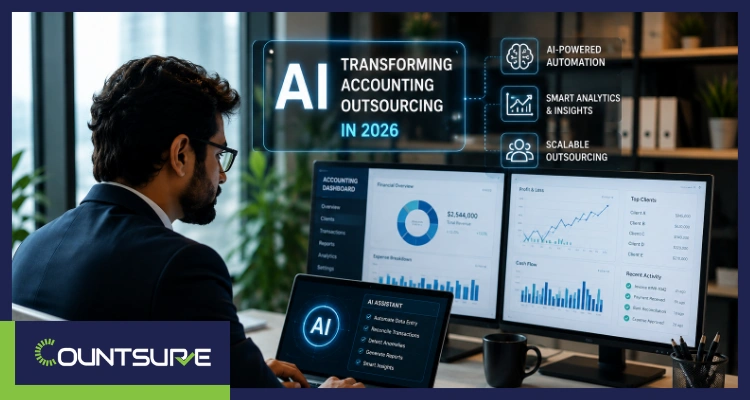
Accounting outsourcing in 2026 no longer looks like a team quietly moving invoices between folders. It looks like software that reads a receipt in seconds, matches it to a purchase order, flags a duplicate, drafts a journal entry, and hands a clean summary to a human reviewer before lunch. That shift is being driven almost entirely by AI, and it is changing how startups, CPA firms, and growing businesses buy accounting services. At Countsure, we work with US companies that use outsourced accounting not just to save money, but to plug into an AI-enabled workflow that scales faster than in-house hiring ever could.
This guide breaks down what AI in accounting outsourcing actually means in 2026, which tasks are being automated, what humans still handle, and how to choose a partner that gets the mix right.
Key Takeaways
- AI is now core to outsourcing, not optional. Modern outsourced accounting firms run AI-driven bookkeeping, reconciliation, and reporting as a default layer beneath every deliverable.
- The biggest gains are in speed and accuracy. AI cuts month-end close times, reduces manual entry errors, and surfaces anomalies that human reviewers can act on quickly.
- Humans still own judgment, advisory, and compliance sign-off. AI handles data; qualified accountants handle interpretation, strategy, and regulatory responsibility.
- Cost structures are shifting. AI-powered outsourcing lets firms deliver more work per dollar, which lowers pricing for clients without cutting quality.
- Real-time reporting is the new standard. Cloud accounting platforms plus AI mean owners can see cash position, receivables, and profitability daily, not monthly.
- Data security and AI governance matter more than ever. Choose partners with clear controls on client data, model use, and SOC 2 alignment.
- Startups and CPA firms benefit differently. Startups gain a full finance stack cheaply; CPA firms use AI outsourcing to scale seasonal capacity without adding headcount.
- The future belongs to hybrid teams. The winning model in 2026 is human plus AI, not one or the other.
What Is AI in Accounting Outsourcing?
AI in accounting outsourcing is the use of machine learning, generative AI, and intelligent automation by an outsourced provider to run bookkeeping, tax, payroll, reporting, and advisory tasks faster and with fewer errors than manual work alone.
In practice, this means an outsourced team is not just doing your books in QuickBooks or Xero. They are pairing those platforms with AI tools that classify transactions, extract data from invoices, reconcile accounts, forecast cash flow, and highlight compliance risks in real time. The human accountant reviews, adjusts, and signs off.
That combination is what separates a modern outsourcing partner from a traditional one in 2026.
How Is AI Transforming Accounting Outsourcing in 2026?
Four shifts stand out. Each one changes what clients expect from an outsourced firm.
Automated bookkeeping and data entry
Intelligent document processing tools now read invoices, receipts, and bank statements with strong accuracy, then push clean entries into the general ledger. According to research from the AICPA and Journal of Accountancy, firms adopting AI-driven bookkeeping report meaningful reductions in manual data entry time, freeing accountants for review and advisory work. Outsourced providers pass those efficiencies directly to clients through lower fees and faster turnaround.
Smart bank reconciliation
AI matches transactions across bank feeds, credit cards, payment processors like Stripe and PayPal, and the general ledger. Instead of an accountant scrolling through hundreds of lines each month, the system reconciles the routine 90 percent and flags the exceptions. That is why our team at Countsure’s offshore bookkeeping service can close books for multi-entity clients in days rather than weeks.
AI-powered financial reporting
Real-time dashboards replace static month-end PDFs. AI pulls data from the accounting system, categorizes it, and generates P&L, cash flow, and KPI reports that update daily. Founders and CFOs stop waiting for the 15th of the following month to see how the business is performing.
Predictive analytics and advisory
Generative AI is now good at turning transaction data into forward-looking insights. Cash runway forecasts, customer profitability analysis, and scenario modeling that used to require a senior analyst can be drafted in minutes and refined by a human accountant.
Ready to see what AI-powered outsourced accounting looks like for your business?
Talk to our team at Countsure and get a walkthrough tailored to your stack, whether you run on QuickBooks, Xero, NetSuite, or Sage.
Talk to Our Experts at CountsureWhat Accounting Tasks Can AI Automate Today?
Not every accounting task is AI-ready in 2026. The table below shows where AI is fully capable, where it assists, and where humans still lead.
| Accounting Task | Manual (Legacy Model) | AI-Automated (Modern Model) |
| Invoice data entry | Typed line by line | Extracted automatically with intelligent document processing |
| Bank reconciliation | Line by line matching | AI matches 85 to 95 percent; humans review exceptions |
| Transaction categorization | Manual coding | AI classifies based on history and rules |
| Expense management | Paper receipts, spreadsheets | AI scans receipts, categorizes, applies policy |
| Accounts payable | Manual review and approval | AI routes, flags duplicates, schedules payments |
| Accounts receivable | Manual invoicing and follow-up | AI drafts invoices, sends reminders, predicts late payers |
| Financial reporting | Static end-of-month reports | Real-time dashboards updated automatically |
| Tax preparation | Manual document collection | AI extracts, organizes, and pre-fills forms |
| Audit sampling | Random small samples | AI reviews 100 percent of transactions for anomalies |
| Advisory and strategy | Fully human | AI drafts insights; humans finalize decisions |
The pattern is clear. Anything transactional, repetitive, or rule-based is now AI territory. Anything requiring judgment, client context, or regulatory accountability still belongs with your accountant.
Not sure which parts of your accounting workflow are ready for AI?
Our experts will map your process end to end and show exactly where automation makes sense. Get in touch through Countsure.
Talk to Our Experts at CountsureWhat Are the Real Benefits of AI in Outsourced Accounting?
For a US small business or CPA firm, the benefits stack up in five clear categories.
Lower costs without lower quality. AI does the volume work, so outsourced providers can price more competitively. Clients get the same closes, cleaner reports, and better analytics at a lower monthly fee than a full in-house hire.
Faster close cycles. Businesses that used to close books in 15 to 20 days now close in 3 to 7. That means faster tax filings, faster board reporting, and faster investor updates.
Fewer errors. Manual entry is the single biggest source of bookkeeping errors, a pattern we cover in detail in our post on common bookkeeping mistakes small businesses should avoid. AI removes most of that risk before a human ever touches the file.
Scalability on demand. Seasonal spikes, acquisitions, or sudden growth no longer require hiring sprints. AI-enabled outsourced teams absorb volume without missing service levels.
Better decisions. With real-time data and predictive analytics, founders and CFOs stop making decisions on last quarter’s numbers. They act on this week’s.
How Does AI Improve Tax Preparation and Compliance?
Tax and compliance are where AI has quietly become indispensable in 2026.
AI-assisted tax preparation tools pull data directly from accounting platforms, categorize it against current IRS rules, and pre-fill federal and state forms. For CPA firms during peak season, that means one preparer can handle two to three times the return volume they used to. We break the economics down in our guide on why CPA firms are outsourcing bookkeeping and tax preparation in 2026.
Compliance monitoring is another area where AI shines. Instead of quarterly reviews, AI continuously scans transactions for sales tax nexus issues, 1099 thresholds, payroll tax deadlines, and anomalies that could trigger an audit. When something looks off, it alerts the accountant before the deadline, not after.
For businesses navigating multi-state or multi-country compliance, this shift is a game changer. The system watches everything; humans focus on strategy and sign-off.
Tax season stress is optional in 2026.
Our team combines AI-enabled workflows with senior US tax reviewers to keep your filings clean, on time, and audit-ready. Start with a free consultation at Countsure.
Talk to Our Experts at CountsureHuman vs AI: Who Should Really Be Handling Your Books?
This is the question every founder and firm owner asks. The honest answer is that neither alone is enough.
| Approach | Speed | Accuracy | Cost | Judgment and Strategy | Best For |
| Human-Only Team | Slow to moderate | Depends on skill and fatigue | Highest | Strong | Very small firms with simple books |
| AI-Only Software | Very fast | High for routine, weak on edge cases | Lowest | None | Solo freelancers with minimal complexity |
| Human + AI (Outsourced) | Fast | Highest overall | Balanced | Strong | Startups, SMEs, CPA firms, growing businesses |
Human plus AI wins in almost every scenario for a real business. AI removes the drudgery; humans provide the judgment, client relationship, and regulatory responsibility. A good outsourced partner designs the workflow, so both play to their strengths.
That is exactly the model we use across accounting, audit and assurance, and payroll services at Countsure.
What Are the Risks of AI in Accounting Outsourcing?
AI is powerful, but it is not risk free. In 2026, there are three risks every buyer should ask about.
Data security. AI tools need access to financial data. Your outsourcing partner must have documented controls on encryption, access management, and vendor use of client data for model training. Look for SOC 2 alignment and a clear stance on whether client data is ever used to train third-party models. Our approach is detailed on our data security page.
Model errors and hallucinations. Generative AI can be confidently wrong. If nobody reviews the AI’s work, mistakes flow straight into the ledger. This is why the human review layer is non-negotiable.
Over-reliance and lost skills. Firms that lean fully on AI without training their people risk losing the judgment that made them valuable in the first place. The best partners use AI to elevate their accountants, not replace them.
Ask any potential provider how they mitigate all three. If they cannot answer clearly, keep looking.
Not every AI-powered provider treats your data the same way.
Ask us about our security, review layers, and compliance framework at Countsure before you commit to any partner.
Talk to Our Experts at CountsureHow to Choose an AI-Powered Accounting Outsourcing Partner in 2026?
Use this quick checklist when evaluating providers.
- Ask which AI tools they actually use in bookkeeping, reconciliation, tax, and reporting. Vague answers mean the AI story is marketing, not workflow.
- Confirm human review at every stage. No AI output should reach your books unreviewed.
- Check credentials. Senior CPAs, EAs, and qualified reviewers should own the final work.
- Verify integrations with your stack including QuickBooks, Xero, NetSuite, Sage, Bill.com, Gusto, and Stripe. We cover the QuickBooks and Xero decision in our cloud accounting comparison for US SMBs.
- Review data security posture. SOC 2, encryption, access logs, and clear data handling policies are baseline.
- Look at real-time reporting. If you cannot see live dashboards, the AI is not doing its job.
- Test transition support. A good partner runs a clean migration with parallel review before switching you over fully.
- Match the model to your size. Startups need a virtual finance team; CPA firms need scalable capacity; enterprises need multi-entity handling.
Firms that check all these boxes deliver the real promise of AI in accounting outsourcing. The rest are catching up.
Wrapping Up: The Future Is Human + AI, Delivered Through Outsourcing
AI is not replacing outsourced accountants in 2026. It is making them significantly more useful. Businesses that pair a strong outsourced team with modern AI tooling close books faster, file taxes cleaner, spot risks earlier, and make better decisions on live data. That is the standard now, and it will only sharpen through the rest of the decade.
Countsure is built for exactly this shift. We combine senior US-focused accountants and CPAs with AI-driven workflows across bookkeeping, tax, payroll, audit, valuation, and CFO services for startups, CPA firms, e-commerce brands, healthcare businesses, and growing enterprises. If you are weighing an outsourcing partner or ready to move off manual, spreadsheet-heavy accounting, get in touch with our team for a free assessment of your current setup and a clear plan for what AI-powered outsourcing could look like for your business.
Frequently Asked Questions
1. Will AI replace outsourced accountants completely?
No. AI handles data-heavy, repetitive work, but qualified accountants own judgment, advisory, regulatory sign-off, and client strategy. The winning model in 2026 is human plus AI, not either alone.
2. Is AI-powered accounting outsourcing safe for financial data?
It can be, if the provider has SOC 2 alignment, strong encryption, access controls, and clear policies on how AI tools use client data. Always ask whether your data is ever used to train third-party models.
3. How much can AI in accounting outsourcing save my business?
Most SMEs and CPA firms see 40 to 60 percent savings compared to in-house hires, plus faster close cycles and fewer errors. Actual savings depend on volume and complexity.
4. Which accounting tasks are best suited for AI automation?
Data entry, bank reconciliation, transaction categorization, invoice processing, receipt scanning, payroll runs, and real-time reporting. Judgment-heavy work like tax strategy and audit sign-off stays with humans.
5. Can small businesses afford AI-powered outsourced accounting?
Yes. AI actually makes outsourcing cheaper for small businesses, since providers pass the efficiency gains through in monthly pricing. A startup can access enterprise-grade tooling at a fraction of building it in-house.
6. How is AI improving tax preparation for CPA firms?
AI pulls source data, categorizes it, pre-fills forms, monitors deadlines, and flags anomalies. This lets one preparer handle two to three times the return volume during peak season without dropping quality.
7. What is the difference between AI bookkeeping software and AI-powered outsourcing?
Software alone gives you tools. AI-powered outsourcing gives you tools plus a qualified team that reviews, corrects, advises, and takes responsibility for the output. Most businesses need both.
8. How do I get started with AI-powered accounting outsourcing?
Start with a short discovery call, share your current stack and pain points, and let the provider map an AI-plus-human workflow tailored to your business. Countsure offers a free assessment as the first step.
Read More:

Parth Shah, Managing Director
(CPA-US, FCA, RV-S&FA, DISA)
Parth Shah who is head of Accounts and Book keeping has experience of more than 10 years. A Certified Public Accountant – US, fellow Chartered Accountant, Registered Valuer and Diploma in Information System Audit.