

How to Prepare for Your First Single Audit: A Step-by-Step Guide
 Parth ShahPublished:November 5, 2026
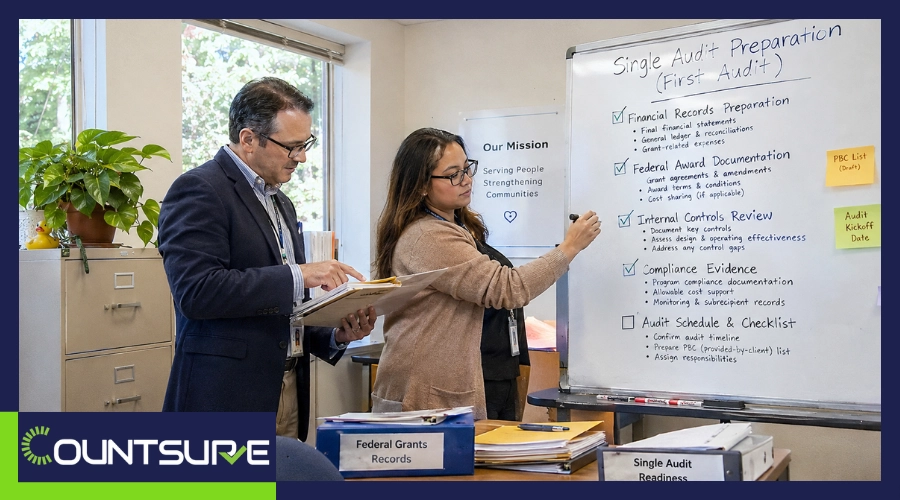
The short answer: To prepare for a single audit, confirm that your federal spending reached $1,000,000 for the year, build a Schedule of Expenditures of Federal Awards (SEFA) that ties to your books, and put the four written policies Uniform Guidance requires in place. Then gather complete files for your largest grants and engage a qualified auditor at least three to four months before year end. Your single audit package is due nine months after year end at the latest.
Your first single audit is the hardest one you will ever have. Everything the auditor tests has to be built for the first time: the federal grant schedule, the written policies, the files behind each grant. Organizations that learn they need to prepare for a single audit after the year closes spend months rebuilding records. Those that start before year end usually finish on time.
Across our audit and assurance work with nonprofits, schools and health centers, Countsure sees the same first-year gaps again and again. This guide walks through the five steps that close them, with a timeline you can put on your calendar today.
Key Takeaways
- To prepare for a single audit, start three to four months before your fiscal year ends, not after it.
- A single audit is required once you spend $1,000,000 or more in federal awards in a fiscal year beginning on or after October 1, 2024.
- Your SEFA must list every federal program with its Assistance Listing number and tie to your general ledger.
- Uniform Guidance requires four written documents: cash management procedures, cost allowability procedures, procurement procedures and conflict of interest standards.
- Your auditor must perform the audit under Government Auditing Standards, also called the Yellow Book.
- The single audit package is due to the Federal Audit Clearinghouse within 30 days of the auditor’s report or nine months after year end, whichever comes first.
What Makes a First Single Audit Different?
A first single audit is different because the auditor tests your compliance with federal grant rules, not just your financial statements. A regular audit asks whether your numbers are right. A single audit also asks whether you followed the rules attached to the federal money you spent.
That means the auditor looks at things a regular audit never touches:
- Whether costs charged to each grant were allowed under the grant and federal cost rules
- Whether you drew grant cash only when you needed it
- Whether you followed written purchasing rules and checked vendors
- Whether the reports you sent your funders match your books
In later years, you update files that already exist. In the first year, you build them. That is why the first audit takes the longest and why preparation pays off most.
Step 1: How Do You Confirm You Need a Single Audit?
You confirm it by adding up the federal awards you expect to spend in the fiscal year. If the total reaches $1,000,000, and your fiscal year began on or after October 1, 2024, you need a single audit.
Count more than direct grants. Federal money passed to you through a state agency, county or another nonprofit counts. So do federal loans with ongoing compliance rules and noncash assistance such as donated commodities. Medicare payments for patient care do not count, and Medicaid payments for patient care count only if your state requires it.
Run this projection mid-year, not at year end. A late burst of grant spending in the final quarter is the most common way organizations cross the line without seeing it coming.
Not sure your federal spending will cross $1 million this year?
Step 2: How Do You Build Your Federal Grant Schedule (SEFA)?
You build your SEFA by listing every federal program you spent money under during the year, with the amount spent and the details that identify it. The Schedule of Expenditures of Federal Awards is the backbone of the single audit. The auditor uses it to choose which programs to test, so nothing else can start until it is right.
What Each Line of the SEFA Needs
Each line should show:
- The federal agency that funds the program
- The program name and Assistance Listing number (formerly called the CFDA number)
- The pass-through entity and its award number, if the money came through a state, county or another organization
- Total federal expenditures for the year
- Amounts passed to subrecipients, if you pass any money on
A Sample SEFA, Worked Through
Northside Youth Services is a hypothetical nonprofit with a July 1, 2025 to June 30, 2026 fiscal year. Its first SEFA looks like this:
| Federal agency | Program (Assistance Listing) | Received through | Expenditures |
|---|---|---|---|
| Health and Human Services | Head Start (93.600) | Direct | $540,000 |
| Agriculture | Child and Adult Care Food Program (10.558) | State education agency | $185,000 |
| Justice | Juvenile Justice grant (16.540) | County | $140,000 |
| Labor | WIOA Youth (17.259) | Local workforce board | $160,000 |
| Total federal expenditures | $1,025,000 | ||
The arithmetic is simple: $540,000 + $185,000 = $725,000, plus $140,000 = $865,000, plus $160,000 = $1,025,000. Northside needs a single audit. Notice that three of its four programs came through a state, county or local board. If the finance team had counted only its direct federal grant, it would have shown $540,000 and missed the audit entirely.
Make It Tie to Your General Ledger
Every number on the SEFA must agree with your general ledger and your drawdown records. Set up a separate class, fund or project code for each federal award in your accounting system. Then update the SEFA monthly. A schedule built for the first time after year end almost always contains differences that take weeks to trace.
Step 3: Which Written Policies Does Uniform Guidance Require?
Uniform Guidance requires four specific written documents, and auditors check for each of them in a first single audit. Practices that “everyone knows” do not count. If it is not written down and approved, the auditor treats it as missing.
| Required document | What it covers | Rule |
|---|---|---|
| Cash management procedures | How and when you draw federal cash, so money is not held before it is needed | 2 CFR 200.302(b)(6) |
| Cost allowability procedures | How you decide whether a cost can be charged to a federal award | 2 CFR 200.302(b)(7) |
| Procurement procedures | How you buy goods and services with federal money, including competition and documentation | 2 CFR 200.318(a) |
| Conflict of interest standards | Rules for staff, officers and board members involved in selecting or managing contracts, with disciplinary actions | 2 CFR 200.318(c)(1) |
Controls the Auditor Will Test Next to the Policies
Written policies are only half of it. The auditor will also test whether you followed them. Three controls come up in almost every first single audit:
- Time records for grant-funded staff. Salaries charged to a grant must be supported by records showing the time actually worked on it.
- Vendor exclusion checks. Before paying a vendor $25,000 or more with federal money, or passing money to a subrecipient, check that they are not suspended or debarred on SAM.gov. Save the result in the vendor file.
- Subrecipient monitoring. If you pass federal money to other organizations, you must tell them the award details and monitor how they spend it.
Step 4: What Grant Files Should You Gather Before Fieldwork?
Gather a complete file for each federal program, starting with your largest. Your biggest programs are the ones most likely to be tested in detail as “major programs.”
Each grant file should contain:
- The award letter or contract, and any amendments
- The approved budget and any budget revisions
- Drawdown or reimbursement requests, with the support behind each one
- Financial and performance reports sent to the funder
- Monitoring letters or site visit results from the funder
To see what the auditor will test for each program, look up the program in the OMB Compliance Supplement, which is updated each year. It lists which compliance areas, such as allowable costs, cash management, eligibility, procurement and reporting, apply to each federal program. Reviewing it before the auditor arrives tells you exactly which files to strengthen. If you run health center programs, our guide to FQHC audits for community health centers covers the HRSA grant areas auditors focus on, and our page on audits for healthcare nonprofits covers the patient revenue questions that sit alongside them.
Step 5: How Do You Choose a Qualified Single Audit Auditor?
Choose an auditor who performs single audits under Government Auditing Standards and has experience with your type of organization and programs. Not every CPA firm does single audits. The Yellow Book sets its own independence and continuing education requirements, and the auditor must meet them.
Ask any auditor you are considering:
- How many single audits they perform for organizations like yours
- Whether their staff meet Yellow Book training requirements
- How they will communicate likely findings during fieldwork, not only in the draft report
- Whether they will help you file with the Federal Audit Clearinghouse
Keep your bookkeeper and your auditor separate. An auditor cannot audit records it prepared. If the firm that keeps your books also offers audits, it generally cannot audit you. For more on how audits are scoped and run, see our audit and assurance FAQs.
What Does a Month-by-Month Timeline for a First Single Audit Look Like?
A realistic first single audit runs from about four months before year end to about six months after it. The table below works for any fiscal year. Count from your own year-end date.
| When | What to do |
|---|---|
| 4 months before year end | Project federal spending. Engage your auditor. |
| 3 months before year end | Adopt the four written policies. Start monthly SEFA updates. |
| 1 to 2 months before year end | Build grant files for the largest programs. Fix time records and vendor checks. |
| Year end | Close the books. Record grant receivables and payables. |
| 1 to 2 months after year end | Finalize the trial balance and SEFA. Send the auditor's document list. |
| 2 to 4 months after year end | Fieldwork. Answer auditor questions quickly. |
| 5 to 6 months after year end | Review the draft report. Write corrective action plans for any findings. |
| No later than 9 months after year end | Submit the package to the Federal Audit Clearinghouse. |
For a June 30 year end, that means engaging an auditor by early March and filing no later than March 31 of the following year. Leaving room before the nine-month deadline protects you if fieldwork runs long.
What Are the Most Common First-Year Single Audit Mistakes?
Most first-year problems come from four gaps that are easy to fix in advance and hard to fix afterward.
- Building the SEFA after year end. The schedule does not tie to the ledger, and the audit stalls until it does.
- No written procurement or conflict of interest policy. Purchases may have been fine, but without the written rules the auditor reports a finding.
- Salaries charged to grants without time records. Estimates or budget percentages do not support the charge.
- Missing pass-through money. A state or county contract turns out to be federal, and the organization learns it needed a single audit too late.
Each of these is a planning problem, not an accounting problem. Fixing them a few months before year end costs far less than explaining them in a published audit report.
Want someone to check your readiness before your auditor arrives?
Frequently Asked Questions About Preparing for a Single Audit
1. How long does a first single audit take?
2. When should we start preparing for our first single audit?
3. Do we need written policies before the audit starts?
Yes. Uniform Guidance requires written cash management, cost allowability and procurement procedures, plus written conflict of interest standards. They should be adopted and in use during the year being audited, not written during fieldwork.
4. Can our bookkeeper prepare the SEFA?
5. Does our auditor need to be Yellow Book qualified?
6. What is the Compliance Supplement?
It is a guide issued by the Office of Management and Budget each year that tells auditors which compliance requirements to test for each federal program. Reviewing it shows you what the auditor will look at for your grants.
7. What happens if we find a problem while preparing?
8. When is our single audit due?
Getting Ready for Your First Single Audit
To prepare for a single audit, start before your year closes: confirm your federal spending, build a SEFA that ties to your books, adopt the four written policies Uniform Guidance requires, and engage a Yellow Book auditor early. The first year is the hardest because every file is new. Organizations that build those files during the year finish on time, while those that start after year end spend months catching up.
- Project your federal spending at mid-year, including pass-through money.
- Adopt the four written policies at least three months before year end.
- Update your SEFA monthly and tie it to the general ledger.
- Engage your auditor about four months before year end.
A first single audit done this way becomes the template for every audit after it.
Ready to plan your first single audit?
Countsure performs single audits under Government Auditing Standards and Uniform Guidance for nonprofits, schools and health centers. Tell us your fiscal year end, your federal grants and your state, and we will confirm the scope and quote a fixed fee before work begins.

Parth Shah, Managing Director
(CPA-US, FCA, RV-S&FA, DISA)
Parth Shah who is head of Accounts and Book keeping has experience of more than 10 years. A Certified Public Accountant – US, fellow Chartered Accountant, Registered Valuer and Diploma in Information System Audit.
