

409A Report Review Case Study
What a Second-Opinion Review Tests in a Platform-Issued 409A Report
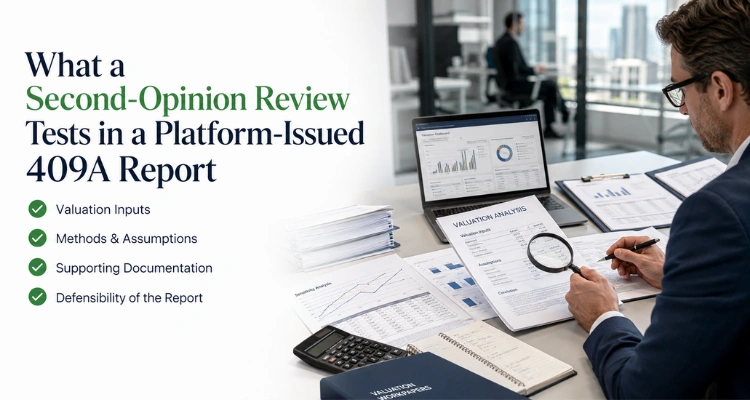
The short answer: a safe harbor 409A is a rebuttable presumption, not a guarantee. When a cap-table platform issues a report and the board grants options against it, the company, not the platform, defends that number to its auditor eleven months later. This case study covers how Countsure reviews a 409A report it did not prepare: the four inputs that get tested, the reasoning that has to be visible in the report itself, and the memo that goes into the client’s audit file before the grant, not after the question.
Key Takeaways
- A 409A valuation review tests support for an existing conclusion. It is not a re-valuation and does not restart the twelve-month safe harbor window
- Safe harbor under the independent appraisal method of Treas. Reg. §1.409A-1(b)(5)(iv)(B)(1) shifts the burden to the IRS, but the presumption can be rebutted where the valuation is shown to be grossly unreasonable.
- Four inputs carry almost all the audit risk: the guideline company set, the marketability discount, the option pricing model allocation, and the ASC 718 reliance language.
- Marketability discounts on early-stage common stock commonly land between 20% and 35%. A figure at the top of that band needs a model output behind it, not a citation to a range.
- A report whose disclosed inputs do not reproduce its own concluded value cannot be defended, and that gap is the first thing an auditor finds.
The Engagement Profile
A venture-backed US company, typically post-Series A with a few dozen employees, holding a 409A report dated to its fiscal year end and delivered five or six weeks later by the cap-table platform that administers its equity. The report concludes a common stock fair market value per share, applies a discount for lack of marketability, values the enterprise on a guideline public company basis using a forward revenue multiple, and allocates equity across the preferred and common classes with a Black-Scholes option pricing model. A board meeting is scheduled to approve new-hire grants, and the finance lead cannot answer why the report chose the multiple and the discount it chose. No working file was delivered with the PDF.
Why a Safe Harbor Report Still Gets Tested
Section 409A applies to nonqualified deferred compensation, and a stock option granted with an exercise price below fair market value on the grant date falls inside it, exposing the option holder to immediate income inclusion, an additional 20% tax under IRC §409A(a)(1)(B), and a premium interest charge. The independent appraisal safe harbor moves the burden of proving unreasonableness onto the IRS, which is a meaningful protection, but it is a presumption rather than a shield. The practical exposure usually arrives earlier and from a different direction: the external auditor testing stock-based compensation, who is not bound by any safe harbor and who applies AU-C 540 to the estimate and its underlying assumptions. That is the review’s real audience. A report that reads complete to a founder can read as a set of unsupported assertions to an auditor, and the difference between the two is whether the reasoning behind each input is visible on the page.
Testing the Guideline Company Selection
The market approach conclusion moves almost entirely with the peer set, so this is where the review starts. The test is whether the selected guideline public companies match the subject company on the drivers that actually explain the multiple, principally revenue scale, growth rate and gross margin, rather than on sector label alone. A forward revenue multiple that is perfectly defensible against a peer group of comparable growth and scale becomes indefensible when the peer set is drawn from companies an order of magnitude larger. Countsure reads the peer list against the subject company’s own financials, checks whether the report discloses the observation date and source of the multiples, and confirms that any size or performance adjustment applied to the selected multiple is explained rather than asserted. Where the peer set is mismatched, the error usually runs in the direction of overstating value, which raises the strike price and cuts against the employees the pool exists to compensate.
Testing the Marketability Discount
A discount for lack of marketability on early-stage common stock generally falls in the 20% to 35% range, and reports frequently land at the top of it. That is not evidence of error, but it is a reason to look. The review asks whether the report shows its work: a put-based model such as Finnerty or Chaffe with the volatility, holding period and strike assumptions that produced the output, or a restricted stock or pre-IPO study with the subject company’s own facts mapped against the study population. Countsure also checks internal consistency, because the volatility and time to liquidity used in the DLOM model should reconcile with the same assumptions used in the equity allocation. A report that runs a five-year expected term through the allocation and a two-year holding period through the discount is telling the reader two different things about the same company. A cited range is not support. A model output with disclosed inputs is.
Testing the Allocation and the ASC 718 Reliance
The review rebuilds the option pricing model allocation from the report’s own disclosures: the breakpoints implied by the certificate of incorporation and the cap table, the liquidation preferences and participation rights at each layer, the volatility source, the expected time to liquidity and the risk-free rate. If the disclosed inputs do not reproduce the disclosed per-share conclusion, something material is missing from the report, and the absence is itself the finding. Separately, Countsure reads the reliance and limiting conditions language. The same common stock value normally feeds grant-date fair value under ASC 718 for the financial statements, and some platform reports expressly limit their use to Section 409A and disclaim financial reporting. Where that language is present, the auditor may decline to accept the report for the stock compensation expense, and the company ends up commissioning a second piece of work mid-audit on somebody else’s timetable.
Our Approach and the Deliverable
Countsure works the report in a fixed order: reconcile the cap table and charter to the share counts and preferences used in the report; rebuild the breakpoint schedule independently; run the allocation from the report’s disclosed inputs and compare the output to its concluded value; test the guideline company set against the subject company’s financial profile; test the marketability discount for model support and internal consistency; and read the scope, reliance and limiting conditions language against the intended uses, including ASC 718.
The deliverable is a review memorandum, not a valuation. It states each test, what the report showed, and whether the conclusion is supported, supported subject to a caveat, or unsupported. Where a caveat exists, the memo names the specific document or workpaper that would close it, so the finance team knows exactly what to request from the original provider. The memo is written to sit in the audit file alongside the report, addressed to the reader who will open it a year later.
What the Review Delivers
- An independent, written assessment of each of the four inputs that carry the audit risk.
- A rebuilt allocation showing whether the report's disclosed inputs reproduce its own concluded value.
- A named list of the specific documents or workpapers that would close any gap identified.
- A clear position on whether the report is usable for ASC 718 grant-date fair value, or only for Section 409A.
- A memorandum written for the audit file, so the reasoning is on record before the question is asked.
Lessons Learned for Founders and CFOs Holding a 409A
- Safe harbor shifts the burden of proof, it does not remove the need for a defensible file.
- Your auditor is not bound by the safe harbor and will test the methodology, the peer set and the discount independently.
- A report you cannot reproduce from its own disclosures is a report you cannot defend.
- Ask for the working file at the time you commission the valuation, not a year later when you need it.
- A marketability discount at the top of the customary band should be a model output, not a selection.
- Check the reliance language before you assume the report supports your ASC 718 expense.
- A review cannot change a strike price already granted, so its value is entirely in what it catches before the next board approval.
- Down rounds and secondary transactions are where allocations most often go wrong, and where a second opinion earns its cost fastest.
Frequently Asked Questions (FAQs)
An independent examination of a valuation report prepared by someone else, testing whether its concluded fair market value is supported by the evidence and reasoning disclosed in the report itself.
No. A new valuation produces a fresh conclusion and a fresh twelve-month safe harbor window. A review documents support for the conclusion you already hold and does not disturb its date.
Before a large grant, ahead of a first audit, when the report comes from a provider you have not used before, and after a down round, where the equity allocation is hardest to get right.
No. A review tests support for a conclusion as of its valuation date. Changing the number requires a new valuation with its own date, and that does not retroactively fix grants already made.
Often, subject to their own testing of methodology, peer set, discount and allocation. Where they push back, the company commissions the fix, usually mid-audit and at short notice.
The review runs from the narrative and disclosed inputs alone, rebuilding the allocation independently. Where the report cannot be reproduced from what it discloses, that absence is recorded as a finding.
Because it moves the conclusion directly and is the input most often stated without support. A discount that cannot be traced to a model output or a study is the easiest assumption for an auditor to challenge.
Not always. Some reports limit their intended use to Section 409A and disclaim financial reporting, in which case the auditor may not accept the number for grant-date fair value in the financial statements.
Holding a 409A Report and a Grant on the Calendar?
If your board is approving options against a report you did not commission and cannot reproduce, an independent review closes the gap on your timetable rather than your auditor’s. Countsure’s valuation team tests the peer set, the marketability discount, the allocation inputs and the reliance language, and delivers a memorandum for your audit file. Visit 409A valuation services or schedule a discovery call and bring the report with you.