

⬤ Business Valuation Services
LLC vs Corporation: Which Structure Fits Your Company?
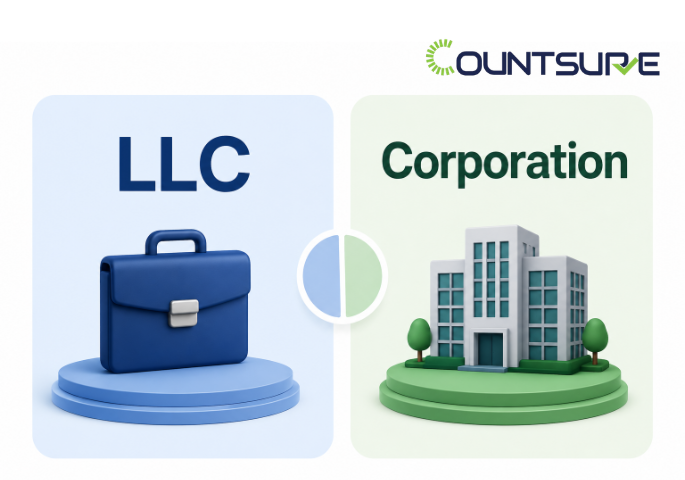
Your legal structure quietly shapes how you get taxed, how you raise money, and how much paperwork lands on your desk every year. For most US businesses the choice comes down to two options: a limited liability company (LLC) or a corporation.
The Short Answer
Picking a legal structure is one of the first real decisions you make as a founder, and the wrong pick can cost you in taxes or investor readiness later. If flexibility and low overhead matter most, an LLC usually wins. If you plan to bring in investors, grant equity, or eventually go public, a corporation is usually the better foundation.
In short: an LLC is owned by members and taxed by default as a pass-through entity, which keeps things simple and flexible. A corporation is owned by shareholders, is a fully separate taxpayer by default, and is built to issue stock and raise outside capital.
Key Takeaways
- An LLC has members; a corporation has shareholders and a board of directors.
- By default, an LLC is a pass-through entity, while a C corporation pays tax at the entity level.
- Both structures shield your personal assets from most business debts and lawsuits.
- Corporations can issue stock and grant employee stock options; LLCs cannot.
- LLCs carry far lighter compliance, while corporations require formal meetings, minutes, and records.
- Either entity can elect S corp taxation if it meets the IRS eligibility rules.
Deciding between the two is rarely obvious on paper. If you are weighing your options, our team can help you form your US LLC or set up a corporation correctly the first time.
What Is an LLC?
A limited liability company is a business entity that combines personal asset protection with flexible, pass-through taxation. Owners are called members, and an LLC can have a single member or many. Both solo founders and business partners use it to keep personal savings, homes, and vehicles separate from business risk. The tax appeal is simple: an LLC does not pay federal income tax as a company. Profits and losses flow through to the members, who report them on their personal returns. If you run solo, a single-member LLC gives you that protection without adding a partner.
What Is a Corporation?
A corporation is a legal entity owned by shareholders but treated as completely separate from the people who own it. Because it exists in its own right, a corporation can hire employees, sign contracts, own property, borrow money, and be sued in its own name. That separation is exactly what makes it attractive to businesses planning to scale. By default the IRS treats a corporation as a C corporation, meaning the company itself pays tax on its profits. Corporations that meet the eligibility rules can instead elect S corp status. Both C corp and S corp are tax designations, not separate legal forms.
The Core Differences at a Glance
LLCs and corporations share a few traits, most importantly limited liability. But they diverge sharply on tax treatment, ownership, fundraising, and day-to-day formality.
|
Feature
|
LLC
|
Corporation
|
|---|---|---|
|
Ownership
|
Members (one or more)
|
Shareholders
|
|
Formation document
|
Articles of Organization
|
Articles of Incorporation
|
|
Default taxation
|
Pass-through
|
C corp (entity-level tax)
|
|
Management
|
Flexible: member- or manager-managed
|
Board of directors and officers
|
|
Raising capital
|
Raising capital
|
Can issue stock; can go public
|
|
Profit sharing
|
Flexible, set by operating agreement
|
Flexible, set by operFixed to share ownershipating agreement
|
|
Employee equity
|
No true stock options
|
No true stock Stock and stock options available
|
|
Ongoing formalities
|
Minimal
|
Meetings, minutes, formal records
|
Formation and Setup
Forming an LLC is the lighter lift. You file Articles of Organization with the state, and the internal rules live in an operating agreement you can tailor to how the owners actually want to work together. There is no board and no mandatory annual meeting to schedule.
A corporation takes more steps. You file Articles of Incorporation, adopt bylaws, and elect a board of directors. Once it exists, the corporation must hold annual shareholder meetings and keep minutes as part of its legal and tax record. Expect more cost and more moving parts at the start.
Management Structure
An LLC lets the members run the business themselves or appoint managers to do it. There is no required chain of command, which suits small teams that want to move quickly.
A corporation runs on a defined hierarchy: shareholders elect the board, the board sets major direction and appoints officers such as a CEO and CFO, and the officers handle daily operations. The structure adds oversight and accountability, which investors tend to like, at the cost of flexibility.
Taxation
This is where the two structures differ most, and where the right choice can save real money.
An LLC is a pass-through by default. Members are treated as self-employed, so profits are reported on personal returns and are generally subject to self-employment tax. An LLC can also elect to be taxed as an S corp, which can reduce that self-employment tax by splitting income between a reasonable salary and distributions. Despite the election, an LLC taxed as an S corp is still an LLC, not a corporation.
A corporation is taxed as a C corp unless it elects otherwise. The company pays the federal corporate income tax on its profits, and shareholders are then taxed again on dividends they receive. That is the double taxation founders often want to avoid. A qualifying corporation can elect S corp treatment to get pass-through taxation instead. The federal corporate income tax rate is 21 percent Because tax outcomes hinge on your income mix and goals, this is worth reviewing with a professional before you commit.
Not sure whether an S corp election makes sense for you?
Our team handles US business tax filing and entity elections every season, mapping the numbers to your actual situation.
Raising Money and Outside Investment
If attracting investors is part of your plan, the corporation has a clear structural edge. It can issue shares, offer common and preferred stock to different classes of investors, and eventually list on a public exchange. Venture and institutional investors are also simply more comfortable buying stock in a corporation.
An LLC cannot issue stock. To bring in an investor, you add them as a member in the operating agreement and allocate them a percentage of the company. That works for smaller, relationship-driven raises but tends to strain as the cap table grows or when priced equity rounds enter the picture.
Profit Distribution
An LLC can split profits however the members agree in writing. A member who does most of the work can receive a larger share than a passive investor, even if their ownership percentages are identical. That flexibility is genuinely useful for partnerships with uneven contributions.
A corporation distributes profits strictly by share ownership. Own 30 percent of the shares and you receive 30 percent of any dividend, with no room to negotiate a different split.
Employee Incentives
Corporations can grant stock and stock options, which is close to standard for attracting and retaining talent at startups and tech companies. Employees expect it, and the mechanics are well understood.
An LLC has no stock to grant. It can build profit-sharing arrangements or synthetic equity that mimics ownership, but these are more complex to design and often less compelling to candidates who understand traditional options.
Health Insurance and Benefits
Both entities can offer retirement plans, life insurance, and paid time off. On health premiums, a corporation has a small edge: premiums for owner-employees are generally fully deductible. In an LLC, a member who owns more than 2 percent must treat health insurance as taxable income, though they can usually deduct it on their personal return
⬤ Shared Ground
Where LLCs and Corporations Actually Overlap
For all their differences, the two share several foundations worth knowing.
Limited liability
In both, owners generally risk only what they put into the business. Personal assets stay protected unless there is fraud or a signed personal guarantee.
State filing
Both must file formation documents and pay state fees, whether that is Articles of Organization or Articles of Incorporation.
Registered agent
Both need a registered agent with a physical in-state address to receive legal documents during business hours.
Annual reporting
Most states require both entities to file annual or periodic reports, usually for a fee, to keep ownership and contact details current.
⬤ The LLC Case
Why Founders Choose an LLC
For lean, owner-operated, or client-facing businesses, the LLC keeps overhead low without giving up protection.
Personal asset protection
Separates your personal finances from business creditors and lawsuits, absent fraud or a personal guarantee.
Tax flexibility
Can be taxed as a sole proprietorship, partnership, or S corp, matching treatment to how the business runs.
Simple to launch and maintain
Paperwork is light, formation is fast, and there is no board or mandatory meeting cycle to manage.
Profit-sharing control
Distribute profits by agreement rather than strictly by ownership percentage.
⬤ The Corporation Case
Why Founders Choose a Corporation
For funded, growth-stage companies with equity to grant and investors to court, the corporation is the natural base.
Investor readiness
The ability to issue common and preferred stock makes raising outside capital far cleaner.
Equity compensation
Stock options are a proven tool for recruiting and keeping key employees.
A path to going public
Only a corporation can list on a public exchange, so it is the base for companies with that ambition.
Tax election options
A qualifying corporation can elect S corp treatment to avoid the C corp double tax while keeping the corporate form.
⬤ Parth Shah’s Expert View
In practice, the question I hear most is “which one saves me more in taxes,” and that framing usually misses the point. The better question is where you want the business to be in three to five years. I have seen founders form a C corporation because a blog told them investors prefer it, then spend years paying for meetings, minutes, and a second layer of tax while running what is effectively a two-person consulting shop. The structure never matched the business.
My general guidance: if you are bootstrapping, running lean, or serving clients directly, start with an LLC and keep the S corp election in your back pocket for when profit justifies it. If you are building something venture-backed with a real cap table and equity for early hires, start as a C corporation and do it cleanly from day one, because converting later is possible but rarely free.
Reviewed by a Licensed US CPA
Parth Shah · US CPA
The right answer is specific to your revenue, your ownership plans, and your funding path. That is exactly the conversation worth having before you file anything.
How to Decide Between an LLC and a Corporation
There is no universal winner. Work through a few honest questions before you file:
- What matters more right now, an easy setup or the ability to attract investors?
- Can you realistically handle the meetings, minutes, and record-keeping a corporation demands?
- How will you fund growth, from your own capital or by selling ownership?
- Do you need to grant equity to employees to compete for talent?
- Are you optimizing for the next twelve months or the next decade?
Your answers usually point clearly in one direction. When they conflict, that is the moment to bring in a professional rather than guess. If your plans include a future sale or fundraise, it also helps to value your company early so the structure supports it.
LLC vs Corporation Questions
Yes. Most states allow a statutory conversion between an LLC and a corporation. It generally involves filing specific state forms and updating your governing documents, and the exact steps vary by state. Because conversion can have tax consequences, it is worth planning with a professional rather than filing on your own.
For most small businesses, an LLC is the more practical starting point. It offers strong liability protection, pass-through taxation, and far less administrative overhead than a corporation. A corporation makes more sense once you need to raise venture capital, issue stock, or grant equity to employees.
They are both tax designations for a corporation, not separate legal entities. A C corp pays tax at the corporate level and shareholders are taxed again on dividends. An S corp passes income through to shareholders to avoid that double tax, but it is capped at 100 shareholders who must be US citizens or permanent residents. An LLC can also elect to be taxed as an S corp.
Generally, yes. An LLC separates your personal assets from business debts and lawsuits, so creditors typically cannot reach your home, savings, or personal accounts. The protection can fail if you commit fraud or personally guarantee a business debt.
It depends on your income, your ownership, and your goals. An LLC’s pass-through treatment avoids double taxation and is often lighter for smaller businesses, while an S corp election can reduce self-employment tax at higher profit levels. A C corporation faces two layers of tax but offers other advantages for funded, growth-stage companies. A CPA can model your specific numbers before you decide.
Yes. Both LLCs and corporations must maintain a registered agent with a physical address in the state of formation, available during business hours to receive legal and official documents.
Get Started
Choose the right entity the first time
Your entity choice affects your taxes and investor readiness for years. Before you file, talk to a licensed US CPA who can map the decision to your actual numbers.
- Free 30-minute consultation with a CPA
- Fixed-fee, fully transparent pricing
- 100% remote - no travel or visa required