

⬤ 409A VALUATION
Fatal 409A Valuation Mistakes
Securing your startup’s financial future demands strict adherence to IRS regulations, and few requirements carry as much weight as a compliant 409A Valuation. It determines the fair market value of your common stock, serving as the ultimate shield against severe tax penalties and investor skepticism. When founders misprice stock options, employees face immediate tax burdens and institutional investors quickly lose confidence during funding rounds.

Fatal 409A Valuation Mistakes That Bankrupt Startups
Securing your startup’s financial future requires strict adherence to IRS regulations, and few requirements carry as much weight as a compliant 409A Valuation. A proper 409A Valuation determines the fair market value of your company’s common stock, serving as the ultimate shield against severe IRS tax penalties and investor skepticism. When founders misprice employee stock options, the fallout extends far beyond accounting errors. Employees face immediate tax burdens, and institutional investors quickly lose confidence during funding rounds.
Getting your valuation right ensures that your employees’ stock options remain an attractive, motivating benefit rather than a surprise financial liability. Accurate valuations protect your team’s hard-earned equity and demonstrate strong corporate governance to future venture capital partners. Knowing exactly when a 409A valuation is required is the first step in maintaining this critical compliance.
This guide breaks down the most critical errors startups make during the appraisal process. By understanding these pitfalls, you will gain a clear roadmap to secure a 100% auditor-approved valuation that protects your company and your workforce.
Don’t leave your compliance to chance. Submit our contact form today to schedule your free 30-minute consultation with CountSure’s valuation experts.
Shield Your Startup from Fatal Valuation Errors.
Don’t leave your compliance to chance. Submit our contact form today to schedule your free 30-minute consultation with CountSure’s valuation experts.
The Problem with 409A Valuations
Determining the fair market value of a private company is a highly complex process heavily scrutinized by both the IRS and institutional investors. Unlike public companies with readily available stock prices, private startups must rely on sophisticated financial models to establish their worth. This complexity often traps founders who attempt to navigate the requirements without specialized guidance.
Rapid company growth, new funding rounds, and shifting market conditions make it exceptionally difficult for founders to maintain accurate fair market value (FMV) on their own. A sudden spike in revenue or a strategic acquisition immediately alters the company’s financial profile. Understanding the 409A valuation process timeline is essential for CFOs who need to keep their equity compensation plans fully compliant without stalling operations.
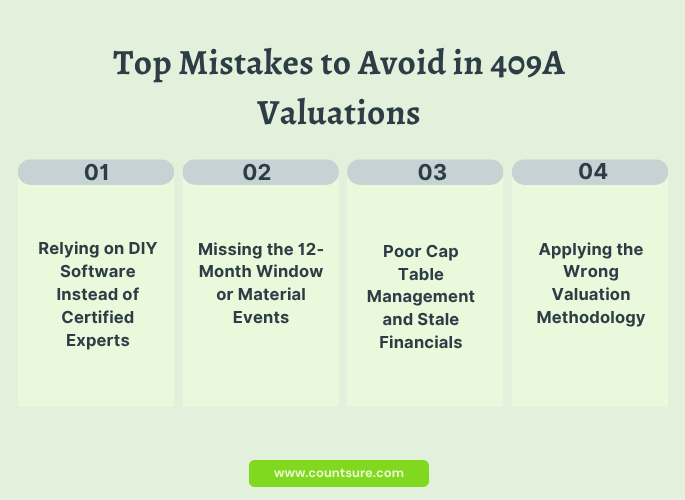
Top Mistakes to Avoid in 409A Valuations
1. Relying on DIY Software Instead of Certified Experts
Automated software often fails to capture the unique nuances of a startup's specific risk profile. Algorithms rely on standardized inputs and generic templates, which frequently overlook complex capital structures or distinct market challenges. This lack of tailored analysis routinely leads to rejected valuations during IRS audits or VC due diligence. Using certified professionals, such as CPAs and Chartered Accountants, guarantees IRS safe harbor protection. Expert appraisers understand how to weigh qualitative factors alongside quantitative data, delivering a defensible report that software simply cannot replicate.
2. Missing the 12-Month Window or Material Events
The IRS enforces a strict rule regarding the validity of your appraisal. A 409A valuation is only valid for 12 months or until a material event occurs. Material events include new equity financing rounds, major acquisitions, secondary market transactions, or significant shifts in the business model. Issuing stock options based on an expired or outdated valuation immediately voids your safe harbor protection. Employees receiving these options face an immediate 20% federal penalty tax on their vested shares, alongside standard income tax and accrued interest.
3. Poor Cap Table Management and Stale Financials
Outdated financial projections, messy capitalization tables, and inaccurate revenue numbers immediately invalidate a valuation. Appraisers rely entirely on the data provided by the company. If your capitalization table fails to reflect recent SAFE notes, or your financial forecasts are disconnected from reality, the resulting valuation will be indefensible. CFOs must synchronize their bookkeeping with the valuation process. Ensuring that your financial statements and cap table are perfectly reconciled before engaging an appraiser prevents costly revisions and audit failures down the line.
4. Applying the Wrong Valuation Methodology
Different company stages require completely different valuation approaches. Using an income approach for a pre-revenue startup yields nonsensical results that instantly flag an audit. Similarly, ignoring the Option Pricing Model (OPM) for startups with complex capital structures involving preferred shares leads to a severe misallocation of value. Certified valuation professionals know exactly which methodology aligns with your specific growth stage, preventing the methodological errors that routinely derail automated reports.
The Overlooked Threat of Unapproved Secondary Transfers
While most founders focus heavily on primary funding rounds, informal secondary transfers often slip under the radar. When early employees or founders sell shares to outside investors without formal board oversight, they inadvertently establish a new baseline for the company’s common stock value. If a startup continues issuing options using an older 409A valuation after a secondary sale has occurred at a higher price, the IRS views those new options as severely underpriced. Monitoring and formally restricting unauthorized secondary transactions is crucial to maintaining the integrity of your current valuation and protecting your team from surprise tax liabilities.
Ready to Reclaim
A Bulletproof 409A Valuation
Are you worried your recent valuation won’t hold up in due diligence? Submit your contact info now to get a defensible, fixed-fee valuation delivered in just 9-12 days.
The Ultimate 409A Audit Survival Checklist for CFOs
Securing a valuation is only half the battle; defending it during a Series A or B funding round is where true preparation pays off. This actionable, VC-focused checklist provides the exact documentation Big 4 auditors demand during due diligence. Following this checklist ensures zero pushback from investors.
Fully reconciled Cap Table
Ensure your capitalization table accurately reflects all recent SAFE notes, warrants, and option grants.
Board meeting minutes
Provide official documentation formally approving the most recent 409A valuation report.
Proof of independence
Maintain documented proof of the valuator’s independence and credentials, specifically verifying CPA or CA backing.
Historical financial statements
Present clean financials that perfectly match the inputs used in the valuation models

Parth Shah's Expert View
(CPA-US, FCA, RV-S&FA, DISA)
CountSure recognizes that continuous compliance is a strategic growth lever, not just a regulatory hurdle. Accurate valuations build investor trust and keep employee morale high.
“The most expensive 409A valuation is the one you have to do twice,” explains Parth Shah. “Startups often seek cheap, automated solutions, only to face $250,000+ in IRS penalties and stalled funding rounds. At CountSure, our CPAs follow a rigorous methodology that secures a 100% auditor acceptance rate, giving founders total peace of mind.”
Frequently Asked Questions (FAQs)
Using outdated financial data, ignoring material events, and relying on non-certified appraisers represent the most frequent errors startups make.
Employees can face an immediate 20% federal penalty tax on their vested options, plus standard income tax and interest.
At least once every 12 months, or immediately following a material event like a new equity financing round.
No. Post-money valuation reflects preferred stock pricing paid by investors, whereas a 409A determines the fair market value of common stock.
Auditors reject reports that lack independent CPA oversight, use incorrect financial models (like skipping the OPM), or rely on stale data.
While software can assist, the IRS safe harbor provision heavily favors valuations finalized and signed off by independent, qualified valuation professionals.
With an expert team like CountSure, a defensible valuation takes about 9-12 days to complete.
Protecting Your Startup's Financial Integrity
The operational and financial risks associated with 409A valuation errors are simply too massive to ignore. Taking shortcuts with automated software or outdated financial data exposes your company to severe IRS penalties and completely stalls venture capital due diligence.
Maintaining strict compliance protects your employees’ equity and streamlines your future fundraising efforts. Startup leaders must partner with proven experts who understand the intricacies of the IRS tax code and the expectations of institutional investors. Working with certified professionals guarantees that your equity compensation plans remain a powerful tool for talent retention.
- Protect your team and your company from unnecessary IRS penalties.