

Late S Corp Election Form 2553 – Complete Guide

Introduction
Picture this: You set up your LLC or corporation last year. You were dealing with clients, managing payroll, and building your business from the ground up. Then, tax season arrives, and your accountant drops a surprise.
“You missed the S corp election deadline.”
You wanted that pass-through tax treatment. You planned your whole financial year around it. And now it feels like you’ve lost thousands of dollars in potential tax savings gone, just like that.
But here’s what most business owners don’t know: you haven’t necessarily lost anything.
The IRS has a built-in rescue procedure called Revenue Procedure 2013-30, and it lets eligible businesses file a late S corp election using Form 2553 sometimes going back up to 3 years and 75 days after the intended effective date. That’s right. You can still get retroactive S corp status, recover those tax savings, and set your business up correctly if you act fast and file correctly.
This guide covers everything you need to know about filing a late S corp election with Form 2553 about what it is, who qualifies, how to fill it out, and what to do if you don’t qualify. Whether you’re a CPA helping a client or a business owner trying to fix a missed deadline, you’re in the right place.
Key Takeaways
- Form 2553 is the IRS form used to elect S corporation tax status for an LLC or corporation.
- The standard deadline is 2 months and 15 days (75 days) from the start of the tax year, typically March 15 for calendar-year businesses.
- Missing the deadline doesn’t automatically kill your S corp election the IRS allows late relief under Rev. Proc. 2013-30, provided you meet the eligibility requirements.
- You can file a late S corp election up to 3 years and 75 days after the intended effective date.
- To qualify, your business must have reasonable cause for the delay, and all shareholders must have filed returns consistent with S corp treatment.
- When filing late, write “FILED PURSUANT TO REV. PROC. 2013-30” at the top of Form 2553. Skipping this step can result in outright rejection.
- You must include a reasonable cause statement on Line I (Part I) of Form 2553, explaining why the election was late and what steps were taken to correct it once discovered.
- If you do not qualify for Rev. Proc. 2013-30 relief, a Private Letter Ruling (PLR) is your only remaining option with IRS user fees currently ranging from $3,450 to $14,500+ depending on your gross income (per Rev. Proc. 2025-1, effective February 2025).
- Working with an experienced tax professional or CPA significantly increases your approval chances and reduces errors.
What Is Form 2553 – And Why Does It Matter?
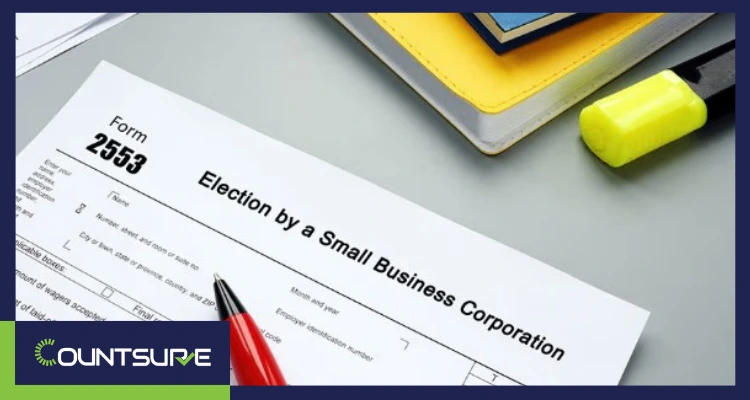
IRS Form 2553, “Election by a Small Business Corporation,” is the official form of your business files to elect S corporation tax status.
Without filing Form 2553, your LLC or corporation is taxed under its default classification either as a C corporation (subject to double taxation), a sole proprietorship (for single-member LLCs), or a partnership (for multi-member LLCs). S corp status is never automatic. It is something you must specifically request from the IRS by filing out this form.
Why does S corp status matter so much? Here’s a quick breakdown:
- Pass-through taxation: Business income flows directly to shareholders’ personal tax returns with no corporate-level federal tax.
- Self-employment tax savings: As an S corp owner-employee, only your salary (not all business income) is subject to self-employment tax.
- Avoid double taxation: Unlike a C corp, you’re not taxed at the corporate level AND again at the personal level.
For a business generating $100,000 or more in net profit, the difference in tax treatment between a C corp/LLC and an S corp can mean thousands of dollars in annual savings.
What Is the Normal S Corp Election Deadline?
The IRS gives you a specific window to file Form 2553. Miss it, and your election is pushed to the next tax year unless you qualify for late relief.
- For new businesses: File Form 2553 within 2 months and 15 days (75 days) of the date your business was formed or first had shareholders.
Example: If your LLC was formed on October 31, 2025, the 2-month period ends on December 31, 2025. Adding 15 days brings your deadline to January 15, 2026 not January 14.
- For existing businesses: File by the 15th day of the 3rd month of the tax year you want S corp status to begin.
For calendar year filers, March 15 falls on a Sunday – deadline extended to Monday, March 16, 2026
Planning: You can also file Form 2553 at any point during the prior tax year for the election to take effect on January 1 of the following year. For example, filing anytime during 2026 would make your S corp election effective January 1, 2027, giving you maximum flexibility without deadline pressure.
What Happens If You Miss the S Corp Election Deadline?
If you miss the deadline and do nothing, your S corp election is treated as effective for the following tax year. That means you lose one full year of S corp tax treatment.
But here’s the good news that the IRS built a lifeline specifically for this situation.
What Is a Late S Corp Election? How Does Rev. Proc. 2013-30 Work?
Revenue Procedure 2013-30 is the IRS procedure that governs late S corporation elections. Before it was introduced, any business that missed the Form 2553 deadline had no simple path forward; they were required to file a Private Letter Ruling (PLR), a process that was expensive, time-consuming, and offered no guaranteed outcome.
Rev. Proc. 2013-30 simplified everything. It allows eligible entities to file Form 2553 after the deadline and have the election treated as if it were filed on time – fully retroactive to the beginning of the intended tax year.
You can request late relief for up to 3 years and 75 days after your intended effective date. Outside this window, Private Letter Ruling becomes your only remaining option.
Example: If you wanted your S corp election to be effective January 1, 2023, → file by March 17, 2026, to file under Rev. Proc. 2013-30.
Missed the S corp election deadline? Don’t guess how to get it right.
Countsure’s tax experts handle late Form 2553 filings with a complete reasonable cause statement, IRS-ready documentation, and zero headaches for you.
Who Qualifies for Late S Corp Election Relief?
Not every business automatically qualifies for late relief. The IRS evaluates four core requirements under Rev. Proc. 2013-30, and failing even one of them can disqualify your election entirely.
1. Intended S corp status from the start: Your business must have genuinely intended to be taxed as an S corporation as of the intended effective date. The IRS does not allow retroactive elections driven purely by financial convenience. If the intent to elect S corp status did not exist at the time, the late relief procedure is not available.
2. Failed only because the election wasn’t filed on time: Your business must meet all other S corp eligibility requirements. The only reason you failed to qualify should be that Form 2553 wasn’t filed on time, not because of an invalid shareholder, multiple stock classes, or other eligibility issues.
3. Reasonable cause for the delay: The IRS requires that you demonstrate a legitimate reason for missing the deadline. Common acceptable reasons include:
- Not knowing a separate election was required beyond forming the entity
- Relying on incorrect advice from a previous tax preparer
- Administrative oversight or miscommunication during the formation process
- Being a new business owner unaware of the filing requirement
4. All shareholders filed consistently with S corp treatment: Every shareholder must have reported their income on tax returns as if the S corp election was already in effect. This means reporting income on Schedule E (from a K-1), not Schedule C (as a sole proprietor). If shareholders filed inconsistently, the process becomes significantly more complicated.
Additional eligibility rules for S Corp status itself:
- Must be a U.S.-formed corporation or LLC
- No more than 100 shareholders
- Shareholders must be US citizens, resident aliens, or specific trust types
- Only one class of stock (voting differences are okay)
- Cannot be an ineligible corporation (financial institutions, insurance companies, etc.)
How to File a Late S Corp Election – Step by Step
Here’s exactly how to file Form 2553 for a late S corp election:
Step 1: Download Form 2553: Download the current version of Form 2553 directly from the official IRS website.
Step 2: Write the Required Header: At the very top of Page 1 of Form 2553 in the top margin write the following exactly as shown:
“FILED PURSUANT TO REV. PROC. 2013-30”
This is not negotiable. Skip it, and the IRS may reject your late election outright.
Step 3: Complete Part I – Basic Business Information
- Box A: Business name, EIN, mailing address
- Box B: Date of incorporation or formation
- Box C: State of formation
- Line E: The date you want you S-Corp status to be effective (usually January 1 of the year in question)
- Line F: Select your tax year (calendar or fiscal)
Step 4: Write Your Reasonable Cause Statement (Line I): This is the most important part of a late election filing. Line I of Part I is where you explain why the election was late and what you did to fix it once you discovered the problem.
Step 5: Get All Shareholder Signatures: Every person who was a shareholder between the intended effective date and the date of filing must sign the Shareholder’s Consent Statement (column K of Part I). Missing even one signature can invalidate the election.
Signature Requirements: Form 2553 requires original wet-ink signatures from all shareholders on the Shareholder’s Consent Statement in Column K, as well as from an authorized officer of the corporation on the signature line at the bottom of Part I. The IRS does not accept electronic signatures, typed signatures, or Docusign on this form. Every signature must be handwritten in ink before the form is submitted by mail or fax.
Step 6: File With the IRS: You have two filing options:
- Option A: If you are filing your S corp tax return (Form 1120-S) at the same time as your late election, attach Form 2553 directly to the front of the return. Write the following notation at the very top of Form 1120-S:
“INCLUDES LATE ELECTION(S) FILED PURSUANT TO REV. PROC. 2013-30”
This tells the IRS processing team that a late election is included and ensures both documents are reviewed together. This option is generally preferred when you are filing back-year returns at the same time as the late election. - Option B: Mail or fax Form 2553 separately to the IRS service center per the instructions in Form 2553. Use certified mail if mailing proves delivery.
Step 7: Wait for IRS Confirmation: After filing, the IRS will send one of two notices:
- CP261: S corp election approved, Keep this notice permanently in your corporate records. The IRS cannot issue a duplicate copy — if lost, you can only request an S corp verification letter (Letter 385C) by calling 1-800-829-4933.
- CP264: S corp election rejected, it will explain the specific reason for denial. File a new, complete Form 2553 addressing the issues identified, or consult a tax professional about your remaining options.
Expect to wait up to 60 days after filing for confirmation. If you haven’t heard back, call the IRS at 1-800-829-4933.
What If You Don’t Qualify for Rev. Proc. 2013-30?
If your business doesn’t meet the requirements (e.g., outside the 3-year and 75-day window or inconsistent shareholder filings), the only option is a Private Letter Ruling (PLR).
The significant downsides of this route are:
Factor | Details |
Cost | IRS user fees under Rev. Proc. 2025-1 (effective February 2025) are: • $3,450 for gross income under $250,000 • $9,775 for gross income between $250,000 and $1 million • $14,500 for gross income over $1 million These fees are in addition to professional fees for preparing the PLR request. |
Time | PLR requests are reviewed by the IRS National Office and can take several months to over a year, with no expedited processing available. |
No Guarantee | Even after paying the user fee and waiting months for a decision, the IRS may still deny the relief request entirely. The fee is non-refundable, regardless of the outcome. |
This is exactly why acting quickly and filing correctly under Rev. Proc. 2013-30 matters so much. The sooner you discover the oversight and file, the better your options.
Common Mistakes That Get Late Elections Rejected
Even well-intentioned late filings get rejected when these mistakes happen:
- Missing the Rev. Proc. 2013-30 header at the top of Form 2553
- Vague or incomplete reasonable cause statement that doesn’t address all four requirements
- Missing shareholder signatures on the consent statement
- Shareholders who filed as sole proprietors (Schedule C) instead of using Schedule E inconsistent reporting
- Being outside the 3-year and 75-day window – the relief period has passed
- Ineligible shareholders – like a partnership or C corporation holding shares
One error can mean starting the whole process over or worse, facing a PLR requirement.
Don’t risk rejection.
Countsure prepares late Form 2553 filings with all required documentation including your reasonable cause statement fully vetted by experienced CPAs.
Can an LLC File a Late S Corp Election?
Yes — and this is one of the most frequently encountered situations in S corp election practice.
An LLC can elect to be taxed as an S corporation by filing Form 2553 with the IRS. If it’s a multi-member LLC, the IRS first treats it as a partnership by default. If it’s a single-member LLC, the IRS treats it as a disregarded entity (sole proprietor).
To become taxed as an S corp, the LLC must:
- Meet all S corp eligibility requirements
- File Form 2553 (on time or via late election relief)
- Optionally file Form 8832 if a formal entity classification change is also needed
For most single-member and multi-member LLCs, Form 2553 alone handles both the entity classification and the S corp election; simultaneously no Form 8832 required.
How Countsure Helps with Late S Corp Elections
At Countsure, we specialize in helping CPA firms and business owners across the United States navigate complex tax situations including late S corp elections.
Our experienced team of CPAs and Chartered Accountants (trained in US GAAP and IRS guidelines) handles the full late election process:
- Eligibility assessment under Rev. Proc. 2013-30
- Preparation of Form 2553 with all required documentation
- Drafting your reasonable cause statement for Line I
- Coordination of shareholder consent signatures
- Filing Form 1120-S for all applicable tax years
- IRS correspondence follow-up if needed
Whether you’re a CPA firm with an overflow of late election cases, or a business owner who just discovered the oversight, Countsure is your trusted back-office partner.
Your data is protected with ironclad NDAs and secure access controls. Confidentiality is our top priority.
Missed the S corp election deadline? Time is on your side but not forever. The window under Rev. Proc. 2013-30 is limited to 3 years and 75 days. Book a free 30-minute consultation with Countsure’s expert CPAs today and find out exactly where you stand.
Conclusion
Missing the S corp election deadline is stressful but for most businesses, it is far from the end of the road. Revenue Procedure 2013-30 exists precisely for this situation, giving eligible businesses up to 3 years and 75 days to file a late Form 2553 and recover fully retroactive S corp status. The window is generous, but it is not unlimited.
The key is acting fast, filing correctly, and having a strong reasonable cause statement. One mistake can mean rejection, and that’s where expert help makes all the difference.
At Countsure, our experienced CPAs handle every step of the late S corp election process from eligibility checks to IRS follow-up, so you don’t have to figure it out alone. Your tax savings are within reach. Don’t let a missed deadline become a missed opportunity.
Frequently Asked Questions (FAQs)
Q1: What is a late S corp election and how does it work?
A late S corp election lets a business claim S corp tax status after missing the Form 2553 deadline. Under Rev. Proc. 2013-30, eligible businesses can file retroactively up to 3 years and 75 days from the intended effective date.
Q2: How long do I have to file a late S corp election after missing the deadline?
You have up to 3 years and 75 days from your intended effective date to request late relief under Rev. Proc. 2013-30. After that window closes, a costly Private Letter Ruling is your only remaining option.
Q3: What counts as a reasonable cause for a late S corp election?
Common reasons include not knowing a separate election was required, relying on incorrect tax advice, or a simple administrative oversight. Your explanation on Line I of Form 2553 must be specific and show you acted quickly once you discovered the mistake.
Q4: Can an LLC file a late S corp election using Form 2553?
Yes – both single-member and multi-member LLCs can file Form 2553 late and qualify for retroactive S corp status. All members must have reported income consistently with S corp treatment, and all standard eligibility requirements must be met.
Q5: What happens if my late S corp election gets rejected by the IRS?
The IRS will send Notice CP264 explaining the rejection. You can respond to fix the specific issues raised or file a Private Letter Ruling which can cost $3,500–$28,000+ with no guaranteed outcome.
Q6: Do all shareholders need to sign Form 2553 for a late S corp election?
Yes – every shareholder from the intended effective date through the filing date must sign the Shareholder’s Consent Statement in column K. Even one missing signature can result in a rejected election.
Q7: What is the difference between filing Form 2553 on time versus filing it late?
An on-time filing is straightforward. A late filing requires writing the Rev. Proc. 2013-30 header on Form 2553, adding a reasonable cause statement on Line I, and potentially filing back-year Form 1120-S returns steps best handled by a CPA.
Q8: Can I file a late S corp election for a prior year if it’s already tax season?
Yes – this is very common. As long as you’re within the 3-year and 75-day window, you can file Form 2553 retroactively even during tax season. You’ll also need to file or amend Form 1120-S for all applicable years.
Read More:

Parth Shah, Managing Director
(CPA-US, FCA, RV-S&FA, DISA)
Parth Shah who is head of Accounts and Book keeping has experience of more than 10 years. A Certified Public Accountant – US, fellow Chartered Accountant, Registered Valuer and Diploma in Information System Audit.