

409A Valuation Methods:
A Founder's Guide to Pre-OPM Value
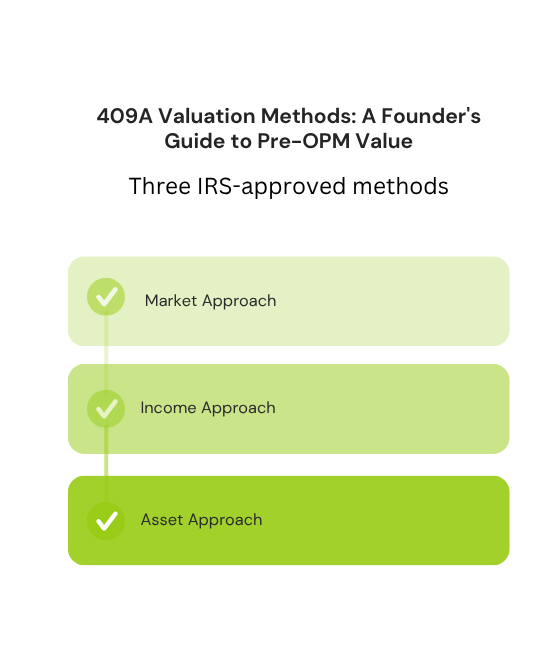
A 409A valuation is essential for any startup issuing equity compensation. It establishes the fair market value (FMV) of your company’s common stock, which is required to avoid severe IRS tax penalties that can stall funding rounds and complicate exit strategies. Before valuation experts can set sa per-share price using the Option Pricing Model (OPM), they must first calculate your company’s total enterprise value. This is done using one of three IRS-approved methods:
Market Approach
Compares your company to similar businesses.
Income Approach
Forecasts future revenue.
Asset Approach
Calculates the net value of your company’s assets.
Understanding these foundational methods will prepare you for annual valuations and new funding rounds, ensuring your company achieves IRS safe harbor and 100% auditor acceptance..
Defining the Baseline: What Are 409A Valuation Methods?
The primary objective of a 409A valuation is to determine the fair market value of a private company’s common stock. This ensures that any stock options issued to employees are priced at or above FMV, granting your company safe harbor protection under IRS Section 409A.
Before determining the per-share value of common stock using the Option Pricing Model, valuation experts must first calculate the total enterprise value of the company. You cannot allocate value across a complex capitalization table without knowing the total value of the business itself.
To find this enterprise value, appraisers use three primary valuation approaches recognized by the IRS and major auditing firms:
- The Market Approach
- The Income Approach
- The Asset Approach
Choosing the right method depends heavily on your company’s current stage of development (from early Seed to Series C and beyond), your specific industry, and the availability of reliable financial data.
The Market Approach: Benchmarking Against Industry Peers
The Market Approach determines a company’s value by comparing it to similar publicly traded companies or recent mergers and acquisitions (M&A) in the exact same industry. It relies on the economic principle of substitution, assuming an investor would pay no more for a private company than the cost of a comparable public asset.
There are two main methods within this approach:
Guideline Public Company Method (GPCM)
This compares the financial ratios of publicly traded companies to your startup. Valuation experts adjust for differences in growth rates, market size, and investment risk.
Guideline Transactions Method (GTM)
This analyzes the financial metrics of comparable private company transactions, such as recent acquisitions, to establish appropriate valuation multiples.
For a rapidly growing SaaS startup, valuation experts might look at the Enterprise Value-to-Revenue (EV/Revenue) multiples of public SaaS companies. If comparable public companies are trading at a 5x revenue multiple, experts will apply a highly scrutinized, risk-adjusted version of that multiple to your startup’s revenue. Because this method relies on observable market data, it is highly defensible and preferred by auditors when reliable peer data is available.

Don't Wait And Be More Efficient With Our 409A Valuation Methods
Parth Shah, Managing Director
(CPA-US, FCA, RV-S&FA, DISA)
Auditors consistently look for the Market Approach in mid-to-late-stage tech and healthcare valuations because it provides a verifiable, data-backed foundation. When applying the Guideline Public Company Method, the secret to achieving a 100% auditor acceptance rate lies in the precise selection of the peer group. A generic tech peer group will invite pushback, whereas a closely matched sub-sector group ensures a smooth audit process.
The Income Approach: Projecting Future Cash Flows
The Income Approach estimates the value of a company by forecasting its expected future cash flows and discounting those figures back to their present value. The most common methodology used here is the Discounted Cash Flow (DCF) method.
Expert valuation teams project the company’s future cash flows, typically over a five-to-ten-year period. They then discount these projections to present value using an appropriate discount rate, known as the Weighted Average Cost of Capital (WACC). This rate accounts for the inherent risks of achieving those projected financials.
The Income Approach is most appropriate for mature, revenue-generating startups such as Series B, Series C, or pre-IPO companies that have stable and predictable financial forecasts. Executing the DCF method correctly requires a deep understanding of capital expenditures, working capital requirements, and growth rates. This complexity reinforces the need to partner with experienced CPAs and Chartered Accountants who can build a model that withstands strict IRS compliance checks.
Book a free 30-minute consultation with CountSure to discuss your financial projections.
The Asset Approach: Valuing the Balance Sheet
The Asset Approach, frequently referred to as the Adjusted Net Asset Method, calculates a company’s value by subtracting its total liabilities from its total fair market value assets.
This method is generally reserved for very early-stage startups, such as pre-revenue Seed stage companies. At this point in a startup’s lifecycle, the company’s value is primarily tied to its tangible assets, like cash from a recent convertible note or SAFE round, rather than historical market data or future revenue projections.
Once high-growth tech, fintech, or AI/ML companies begin generating proprietary intellectual property and recurring revenue, the Asset Approach is rarely used. It simply cannot capture the intangible value of a rapidly scaling business model.
Bridging the Gap: Moving to the Option Pricing Model
Once the valuation experts calculate the total enterprise value using the appropriate method (Market, Income, or Asset), they must transition to determining the per-share value.
The total enterprise value serves as the critical primary input for the Option Pricing Model. The OPM treats different classes of equity as call options on the company’s enterprise value. It takes the total enterprise value and strategically allocates it across the company’s complex cap table, accounting for preferred stock, common stock, options, warrants, and specific liquidation preferences.
A methodical, expert-led transition between the enterprise valuation and the OPM allocation is what guarantees a defensible valuation. A minor error in assessing total enterprise value will compound exponentially once the data hits the capitalization table, highlighting exactly why seasoned CPAs are required for this process.
Secure Your IRS-Compliant Valuation Today
The accuracy of your Option Pricing Model depends on the precision of your 409A Valuation method. Whether using the Market, Income, or Asset approach, an accurate enterprise value is non-negotiable.
The Stakes of Non-Compliance Are High

IRS Penalties
Severe tax penalties can be levied against your employees.

Delayed Transactions:
Risk of delayed M&A events and funding
rounds.

Eroded Trust:
Loss of confidence from investors and
employees.
When IRS compliance and talent retention are on the line, you need a valuation partner you can trust. CountSure delivers defensible 409A valuations that withstand IRS and auditor scrutiny.
FAQs
The three primary approaches to determine enterprise value are the Market Approach, Income Approach, and Asset Approach. Valuators typically consider all three but may weigh them differently depending on the company’s specific circumstances.
The Market Approach compares your company to similar public or private companies. This involves analyzing market multiples, such as revenue or EBITDA, from comparable companies and recent M&A transactions to estimate your company’s value.
The Income Approach focuses on a company’s future earning potential. The most common method is the Discounted Cash Flow (DCF) analysis, which projects future cash flows and discounts them back to their present value to determine the company’s worth.
The Asset Approach calculates a company’s value based on the fair market value of its total assets minus its liabilities. This method is most suitable for very early-stage companies with limited revenue or for businesses facing liquidation.
The Option Pricing Model (OPM) is used to allocate the total enterprise value among the different classes of a company’s stock (e.g., preferred and common). It treats each stock class as a call option on the company’s value, helping to determine the Fair Market Value (FMV) of the common stock required for setting option strike prices.
The most appropriate method depends on your company’s stage of development, industry, and financial profile. Early-stage, pre-revenue startups might rely more on the Asset Approach, while growth-stage companies with predictable cash flows may lean on the Income Approach. A thorough valuation considers a blend of these methods.
A recent arm’s-length funding round provides a strong indicator of value and is often used within the Market Approach. Valuators can use the post-money valuation from the funding round as a key data point, often allocating this value across share classes using the OPM.
Why Choose CountSure?
- Expert-Led Analysis: Valuations conducted by seasoned CPAs.
- Transparent Pricing: Fixed-fee structure ($1,500 - $15,000) with no hidden costs.
- Fast Turnaround: Reports delivered in 9-12 days.
- Guaranteed Acceptance: 100% auditor acceptance rate.
With CountSure, you can issue equity with total peace of mind.
Ready to Get Your IRS-Compliant 409A Valuation?
Schedule a free consultation with CountSure’s valuation experts. We’ll discuss your company’s specific needs, answer all your questions, and provide a transparent quote zero pressure, zero obligations.