

Master 409A Safe Harbor Valuation, Understand the Benefits & Avoid IRS Penalties

Offering equity compensation is essential for attracting top talent, but mispricing stock options can lead to severe IRS penalties. Founders and CFOs must balance issuing equity for growth with adhering to strict tax regulations.
Section 409A of the Internal Revenue Code requires private companies to issue stock options at Fair Market Value (FMV). A 409A safe harbor valuation provides crucial protection against IRS scrutiny. Achieving safe harbor status shifts the burden of proof to the IRS in an audit, protecting your company and employees from significant financial risk.
This guide explains the 409A safe harbor rules, the consequences of non-compliance, and how to ensure your valuation is IRS-compliant.
What Exactly is a 409A Safe Harbor Valuation?
A 409A safe harbor valuation is a legal provision granting a “presumption of reasonableness” to your company’s common stock valuation. To earn this presumption, your company must establish the fair market value using specific, IRS-approved methods.
Without safe harbor status, the burden of proof rests entirely on the company. If audited, you must prove your valuation is correct and accurate. With safe harbor protection, the dynamic flips. The IRS must prove that your valuation methodology is “grossly unreasonable” a significantly higher legal hurdle that strongly deters audits.
Achieving this protected status requires relying on established valuation science. The IRS looks for valuations executed by credentialed, unbiased professionals. Engaging experts like Certified Public Accountants (CPAs), Certified Valuation Analysts (CVAs) ensures your valuation methodology meets strict federal standards and aligns with industry best practices.
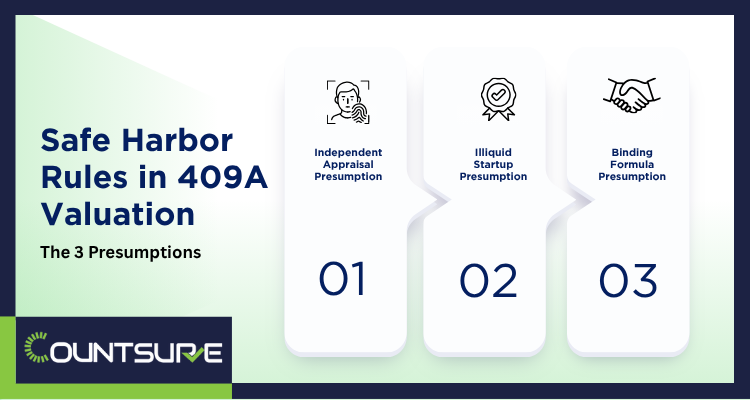
Safe Harbor Rules in 409A Valuation: The 3 Presumptions
The IRS provides three specific, approved methods to achieve safe harbor status. Selecting the right method depends on your company’s age, structure, and stage of growth.
Independent Appraisal Presumption
The independent appraisal presumption is the most common and secure route for SaaS, technology, healthcare, and growing startups. It requires hiring an independent, qualified appraiser to determine the fair market value of your common stock.
A qualified appraiser typically belongs to a firm backed by CPAs or CVAs and valuation experts who hold no vested interest in your company. Because this method relies on rigorous financial analysis and unbiased professionals, it fully satisfies the IRS’s strict requirements and offers the strongest audit defense.
Illiquid Startup Presumption
The illiquid startup presumption applies exclusively to early-stage companies. To qualify, your company must be less than 10 years old, privately held, and not anticipating a change of control such as an IPO, merger, or acquisition within 90 days. Furthermore, the company cannot anticipate a public offering within 180 days.
While this method allows an internal “qualified individual” to perform the valuation, it faces much higher IRS scrutiny. If the methodology is not meticulously documented or the individual lacks sufficient financial expertise, the IRS can easily revoke the safe harbor status.
Binding Formula Presumption
The binding formula presumption applies when a company consistently uses a generally applicable formula to determine stock value. This is typically used by LLCs or defined within specific shareholder agreements. For example, a company might use a consistent revenue multiple or book value formula to price shares for all non-lapse restrictions. All parties must be legally bound by this formula for it to qualify as a safe harbor. However, this method may not be suitable for all businesses and it’s important to consult with a valuation expert before implementing this approach.
Key Requirements for IRS Valuation Compliance
Securing safe harbor is not a one-time event. Private companies must adhere to strict timelines and reporting standards to maintain their IRS valuation compliance.
The 12-Month Rule
A 409A valuation has a strict expiration date. It is only valid for 12 months from the effective date of the report. To maintain continuous safe harbor protection, companies must refresh their valuation annually, even if business operations remain completely stable.
Material Events Require Immediate Action
The 12-month rule only applies if your business remains relatively unchanged. A new valuation is immediately required if a “material event” occurs. A material event is any significant business development that could reasonably affect your company’s stock price. Common triggers include closing a new funding round (Seed, Series A, etc.), executing a significant pivot in your business model, or undergoing a major merger or acquisition. You must update your valuation because of these events before issuing any new options.
Comprehensive Documentation
Thorough documentation forms the backbone of any defensible valuation. The IRS requires a written valuation report that clearly outlines the methodology used. This includes explaining models like the Option Pricing Method (OPM) backsolve or the income approach, alongside a detailed analysis of market factors, comparable transactions, and industry trends.
The Cost of Getting It Wrong 409A Valuation: Risks of Non-Compliance
Issuing options without a valid 409A valuation carries devastating financial and legal consequences. The IRS does not offer a grace period for honest mistakes.
Immediate Taxation and the 20% Penalty
When a valuation is deemed non-compliant, the financial blow falls heavily on your employees. Option holders face immediate income taxation on their vested options, even if they have not exercised them or realized any actual cash gain. On top of standard ordinary income tax, employees are hit with an additional 20% federal penalty tax, plus accumulating interest charges. In some states, local tax penalties push the total tax burden even higher.
Corporate Fallout
The damage extends far beyond individual tax bills. Non-compliance creates a massive corporate liability. Your company will face disrupted due diligence during M&A events and delayed IPOs. Big 4 auditors and potential acquirers will flag non-compliant equity grants, potentially derailing funding rounds. Furthermore, the company risks losing investor trust and faces the threat of lawsuits from employees financially harmed by the invalid valuation.
The Strategic Benefits of Maintaining Safe Harbor Status
Viewing 409A valuations purely as a compliance exercise overlooks their strategic value. Proper valuation management actively supports your company’s growth and stability.
Audit-Ready Peace of Mind
Maintaining a valid safe harbor valuation protects your organization from IRS penalties. This gives the CFO, General Counsel, and executive team the confidence to grant equity and scale operations without fearing sudden regulatory intervention.
Employee Trust and Retention
Equity compensation only works as a retention tool if employees trust it. Compliant valuations assure your team that their stock options are legally sound, fairly priced, and will not result in surprise, ruinous tax bills. Transparent valuation practices build trust and keep your workforce motivated.
Smooth Due Diligence
Investors and acquirers scrutinize cap tables and option grants extensively. A pristine history of IRS valuation compliance accelerates the due diligence process. Big 4 auditors and venture capital firms look for defensible, independent appraisals before approving major funding rounds or lucrative exits.
Securing Safe Harbor with Expert-Led Analysis
When millions of dollars and critical talent are on the line, automated software platforms often fall short. CFOs and startup leaders consistently choose specialized valuation partners over bundled software to ensure truly defensible results.
Partnering with CountSure provides your company with expert-led analysis tailored to your specific capital structure. CountSure’s team of experienced CPAs, CVAs and Chartered Accountants delivers comprehensive, IRS-compliant 409A valuations that boast a 100% auditor acceptance rate.
Choosing a dedicated valuation firm brings significant operational benefits. CountSure provides a fast 9-to-12 day turnaround, ensuring your equity grants are never delayed. Additionally, transparent, fixed-fee pricing based on the complexity of your cap table eliminates hidden costs and budgeting surprises entirely. You receive an audit-ready report backed by lifetime audit defense support.
Safeguard Your Cap Table and Your Team
Maintaining a 409A safe harbor valuation is far more than a regulatory checkbox. It is a critical foundation for equitable compensation, investor trust, and long-term financial security. Failing to secure a defensible valuation jeopardizes your employees’ financial well-being and risks derailing your company’s most important milestones.
Company leaders must proactively monitor their equity compliance. Check the date of your last valuation report today. If it is approaching the 12-month mark, or if you have recently closed a new funding round, a refresh is mandatory.
Secure your company’s compliance and protect your team’s equity. Book a free 30-minute consultation with CountSure’s valuation experts today to discuss your cap table and ensure 100% auditor acceptance for your next 409A valuation.

Parth Shah, Managing Director
(CPA-US, FCA, RV-S&FA, DISA)
Parth Shah who is head of Taxation, Audit and assurance, Business Valuations, 409A Valuations and Book keeping has experience of more than 10 years. A Certified Public Accountant – US, fellow Chartered Accountant, Registered Valuer and Diploma in Information System Audit.
You May Also Like
- All Posts
- 409A valuation
- Accounting
- Audit and Assurance
- Bookkeeping
- Business Management
- Financial Statement
- Form 5472
- Payroll
- SOC 1 SOC 2
- Tax
- USA Company Registration
- Valuation